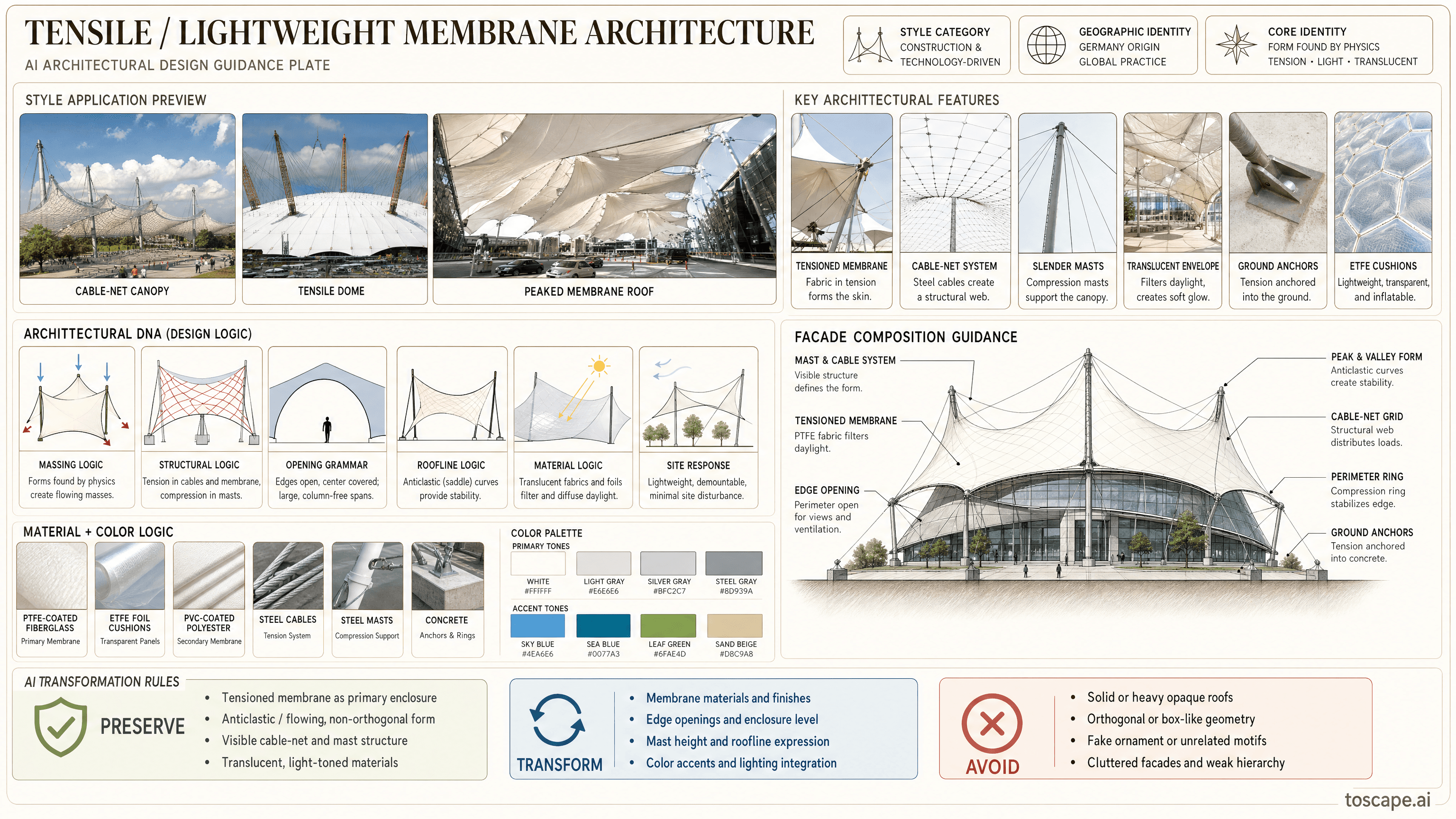
TENSILE / LIGHTWEIGHT MEMBRANE ARCHITECTURE
Germany (Frei Otto, 1950s-70s), global (Horst Berger, Buro Happold); Core identity: Form... / Digital and technology
Form found through physical forces - tensioned cable nets and fabric membranes - minimal structure achieving maximum span - translucent...
Definition
TENSILE / LIGHTWEIGHT MEMBRANE ARCHITECTURE is a global architectural style within the digital and technology. Form found through physical forces - tensioned cable nets and fabric membranes - minimal structure achieving maximum span - translucent.
- Family
- Digital and technology
- Origin
- Germany (Frei Otto, 1950s-70s), global (Horst Berger, Buro Happold); Core identity: Form.
- Massing
- Form found through physical forces - tensioned cable nets and fabric membranes - minimal structure achieving maximum span - translucent PTFE/ETFE or PVC-coated polyester membranes.
- Materials
- Form found through physical forces. Tensioned cable nets and fabric membranes.
Overview
TENSILE / LIGHTWEIGHT MEMBRANE ARCHITECTURE is a global architectural style rooted in Germany (Frei Otto, 1950s-70s), global (Horst Berger, Buro Happold); Core identity: Form found through physical forces - tensioned cable nets and fabric membranes - minimal structure achieving maximum span - translucent PTFE/ETFE or PVC-coated polyester membranes - anticlastic curvature (saddle shapes) for stability - lightweight, demountable, temporary-permanent - architecture as minimal intervention. Form found through physical forces - tensioned...
Visual DNA
Massing & Form
Form found through physical forces - tensioned cable nets and fabric membranes - minimal structure achieving maximum span - translucent PTFE/ETFE or PVC-coated polyester membranes - anticlastic curvature (saddle shapes) for stability -...
Facade Language
Form found through physical forces - tensioned cable nets and fabric membranes - minimal structure achieving maximum span - translucent PTFE/ETFE or PVC-coated polyester membranes - anticlastic curvature (saddle shapes) for stability -...
Materials & Texture
Form found through physical forces. tensioned cable nets and fabric membranes.
Color Palette
Form found through physical forces - tensioned cable nets and fabric membranes - minimal structure achieving maximum span - translucent PTFE/ETFE or PVC-coated polyester membranes - anticlastic curvature (saddle shapes) for stability -...
Ornament & Detail
Tensioned fabric or foil membrane as primary enclosure. Anticlastic (saddle) or flowing catenary form.
Climate Response
Germany (Frei Otto, 1950s-70s), global (Horst Berger, Buro Happold); Core identity: Form found through physical forces. tensioned cable nets and fabric membranes.
Landscape & Ground
Germany (Frei Otto, 1950s-70s), global (Horst Berger, Buro Happold); Core identity: Form found through physical forces. tensioned cable nets and fabric membranes.
Reference elevation
TENSILE / LIGHTWEIGHT MEMBRANE ARCHITECTURE - characteristic facade composition within the digital and technology.
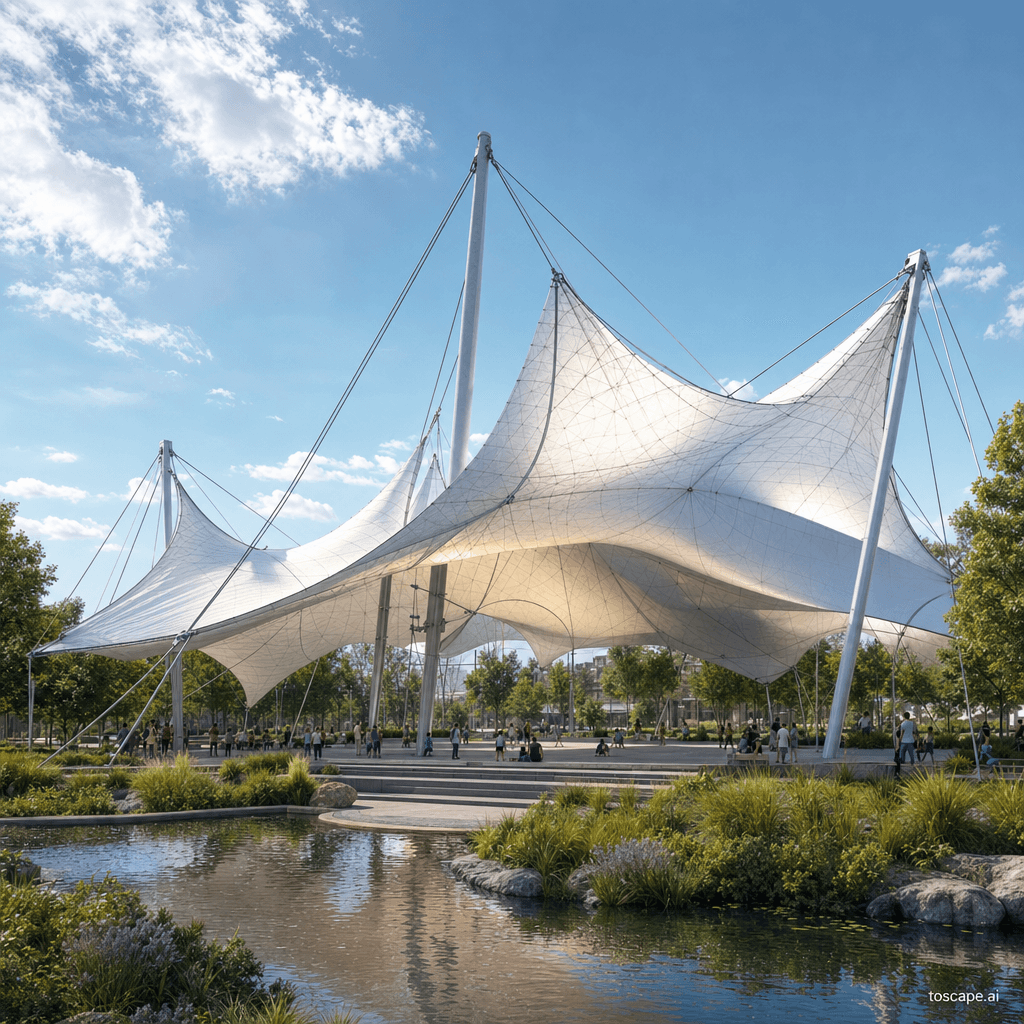
Context Snapshot
Germany (Frei Otto, 1950s-70s), global (Horst Berger, Buro Happold); Core identity: Form found through physical forces - tensioned cable nets and fabric membranes - minimal structure achieving maximum span - translucent PTFE/ETFE or PVC-coated polyester membranes - anticlastic curvature (saddle shapes) for stability - lightweight, demountable, temporary-permanent - architecture as minimal intervention
Contemporary Relevance
Today, TENSILE / LIGHTWEIGHT MEMBRANE ARCHITECTURE remains relevant wherever projects need digital and technology cues without losing performance or contemporary usability. In Toscape it responds best when prompts emphasize form found through physical forces - tensioned cable nets and fabric membranes - minimal structure achieving maximum span - translucent ptfe/etfe or pvc-coated polyester membranes - anticlastic curvature (saddle shapes) for stability...
Use this style in Toscape
Explore TENSILE / LIGHTWEIGHT MEMBRANE ARCHITECTURE directly inside Toscape using Facade Re-Style and design workflow prompts tuned for global architectural references.
Open TENSILE / LIGHTWEIGHT MEMBRANE ARCHITECTURE in the galleryFrequently asked questions
What is TENSILE / LIGHTWEIGHT MEMBRANE ARCHITECTURE?
TENSILE / LIGHTWEIGHT MEMBRANE ARCHITECTURE is a global architectural style within the digital and technology. Form found through physical forces - tensioned cable nets and fabric membranes - minimal structure achieving maximum span - translucent.
What materials define TENSILE / LIGHTWEIGHT MEMBRANE ARCHITECTURE?
Form found through physical forces. Tensioned cable nets and fabric membranes.
What is the TENSILE / LIGHTWEIGHT MEMBRANE ARCHITECTURE color palette?
Form found through physical forces - tensioned cable nets and fabric membranes - minimal structure achieving maximum span - translucent PTFE/ETFE or PVC-coated polyester membranes - anticlastic curvature (saddle shapes) for stability.
What is the origin of TENSILE / LIGHTWEIGHT MEMBRANE ARCHITECTURE?
Germany (Frei Otto, 1950s-70s), global (Horst Berger, Buro Happold); Core identity: Form found through physical forces - tensioned cable nets and fabric membranes - minimal structure achieving maximum span - translucent PTFE/ETFE or PVC-coated polyester membranes - anticlastic curvature (saddle shapes) for stability - lightweight, demountable, temporary-permanent - architecture as minimal intervention.
When should architects use TENSILE / LIGHTWEIGHT MEMBRANE ARCHITECTURE?
Today, TENSILE / LIGHTWEIGHT MEMBRANE ARCHITECTURE remains relevant wherever projects need digital and technology cues without losing performance or contemporary usability.
How do you render TENSILE / LIGHTWEIGHT MEMBRANE ARCHITECTURE in Toscape?
Open Toscape on Windows, load your own photo, elevation, sketch, or CAD view, then apply the TENSILE / LIGHTWEIGHT MEMBRANE ARCHITECTURE reference from the built-in style library. The Facade Re-Style and Design Options workflows keep your project geometry and camera while shifting materials, proportion, and detailing toward TENSILE / LIGHTWEIGHT MEMBRANE ARCHITECTURE.