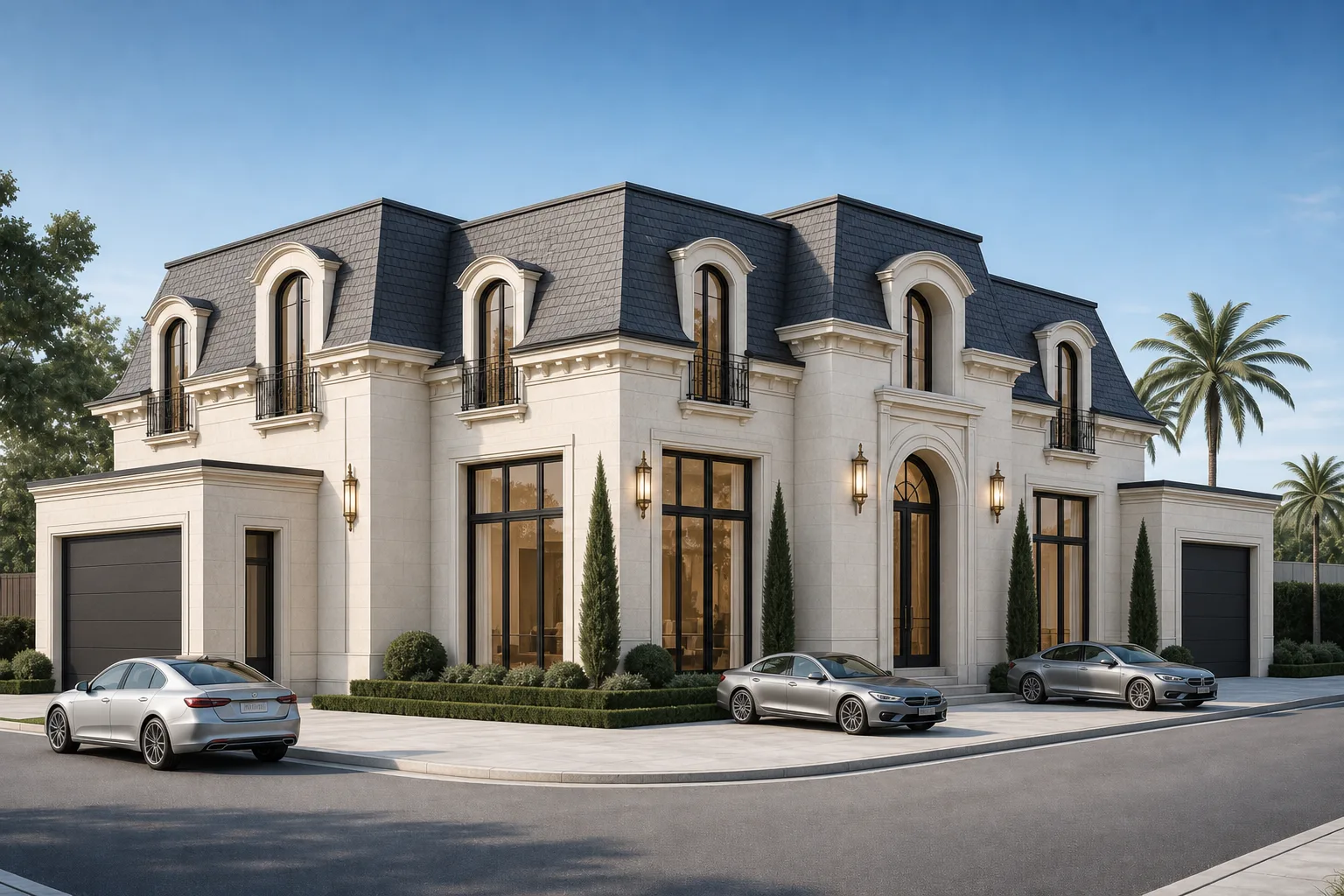
Neo-Mansard Villa with Symmetrical Courtyard Frontage
Architectural Topic
Neo-Mansard Villa with Symmetrical Courtyard Frontage is an architectural gallery study focused on exterior design, using contemporary neo-islamic, exterior, arched openings to explain the image as a practical reference for facade, massing, material, and spatial decisions.
Stylistically the house sits squarely in a neo‑French, late Beaux‑Arts lineage, filtered through contemporary visualization habits. The mansard roof with slate‑like tiling, dormer windows with arched pediments, pronounced cornices, and symmetrical composition all recall Parisian hôtel particuliers, yet the façade is stripped of overt ornament and relies on proportion, clean jointing, and large glass planes for effect. Verticality is emphasized through tall, almost commercial-scale openings at ground level inset within a pale stereotomic base, while the upper floor adopts a more perforated, repetitive fenestration strategy. The resulting tectonic legibility gives the house a clear massing hierarchy: heavy stone body below, lighter roof volume above.
Formally, the massing reads as a compact bar with shallow projections at the center and ends, establishing a primary central axis anchored by the arched entry. This entry bay thickens the wall, creating a minor stereotomic bulge that reinforces its role as datum in the composition. The garages are conceived as orthogonal side blocks whose lower height and flat roofs reduce their visual weight; they operate as lateral buttresses that frame the main volume rather than competing with it. Dormers are carefully positioned in a three‑part rhythm, syncing with the vertical bays below, so that the roof becomes an inhabited attic band rather than a mere cap, strengthening the sense of a continuous volumetric stack.
The horizontal–vertical interplay is disciplined. Strong horizontal cornices terminate the ground floor and define the eaves, creating clear shadow lines that make the load path intuitively legible: stone piers rise from the ground to support the entablature, above which the mansard appears as a lighter, almost timber‑framed shell. Tall ground‑floor openings extend close to the pavement, elongating the façade and suggesting double‑height interiors where vertical mullions act as slender structural and visual members. The dormer windows, by contrast, are narrow and more domestic in scale, their small Juliet balconies hinting at private rooms tucked into the roof thickness, increasing vertical stratification between public and private zones. Envelope logic is straightforward but carefully tuned. At ground level, full‑height glazing is consolidated into large, dark‑framed panels set deeply into a pale stone cladding system, likely a high‑quality veneer over conventional wall build‑up rather than true load‑bearing ashlar. This depth at the reveals, coupled with the projecting cornices, generates effective micro‑shading while preserving visual permeability between interior and garden. The upper‑level fenestration adopts arched heads and thickened surrounds that act almost as miniature facades within the façade, reinforcing the hierarchy between levels. Texture is controlled: smooth stone faces, crisp arrises at the pilaster‑like corners, and regularly coursed joints contrast against the fine‑scaled slate pattern of the mansard, creating a readable material stratigraphy from street level to skyline. Light and landscape are handled with a certain restraint. Morning or late‑afternoon sun grazes the façade, catching the cornice, pilaster caps, and window surrounds, which strengthens the stereotomic reading and prevents the pale cladding from flattening out. Landscaping is clipped and orthogonal: low hedges and vertical cypress‑like elements echo the façade’s vertical bays and reinforce the axial emphasis of the entrance. Palms in the distance introduce a looser, climatic context that complicates the historical reference—this is clearly not Paris, but a transposed typology adapted to a warmer, perhaps coastal setting, where the deep window reveals and mansard overhang incidentally support solar control. As an experience, the sequence promises a calibrated transition from public street to controlled, almost theatrical interior. One moves along the curved curb into a forecourt defined not by walls but by the aligned façades and repetitive lanterns, then up a short stoop through the arched portal into what is likely a tall, light‑filled hall framed by those expansive panes. The architecture reads contemporary less through form than through precision: lean profiles, large single panes rather than divided lights, and an absence of overt historicist decoration. It is easy to imagine façade studies for such a project being iterated through concept‑render tools like https://www.toscape.ai/, where minute adjustments to cornice depth, dormer spacing, or stone tone can be tested rapidly, a workflow that is starting to reshape how classically inflected domestic architecture negotiates between nostalgic image and performative envelope.
Materials
The material reading is driven by mineral and stone-like tones, using surface depth, shadow, and warm neutral coloration to strengthen the facade's architectural identity.
Style
The style direction reads as contemporary neo-islamic, supported by exterior and arched openings.
Explore Regional & Global StylesBuilding Type
Luxury Villa
Facade Logic
The facade logic is organized around organic or parametric articulation, where repeated surface movement creates a unified envelope rather than a flat decorative skin.
Explore Related Keywords
1536 × 1024 px
Generation Receipt
Deterministic pipeline: the workflow, style direction and output size below are locked at generation time, so the same inputs reproduce the same visual language.
- Workflow
- Toscape workflow
- Style direction
- Explore Regional & Global Styles
- Output
- 1536 x 1024 px
More from this category


Academy links
Material Swap for Facades and Interiors
Study how material changes alter facade and interior perception.
Re-Render for Concept and Client Review
Learn how to refine existing concepts while protecting studio imagery.
Integrating Toscape into Architectural Production
Connect AI image studies with professional studio workflows.