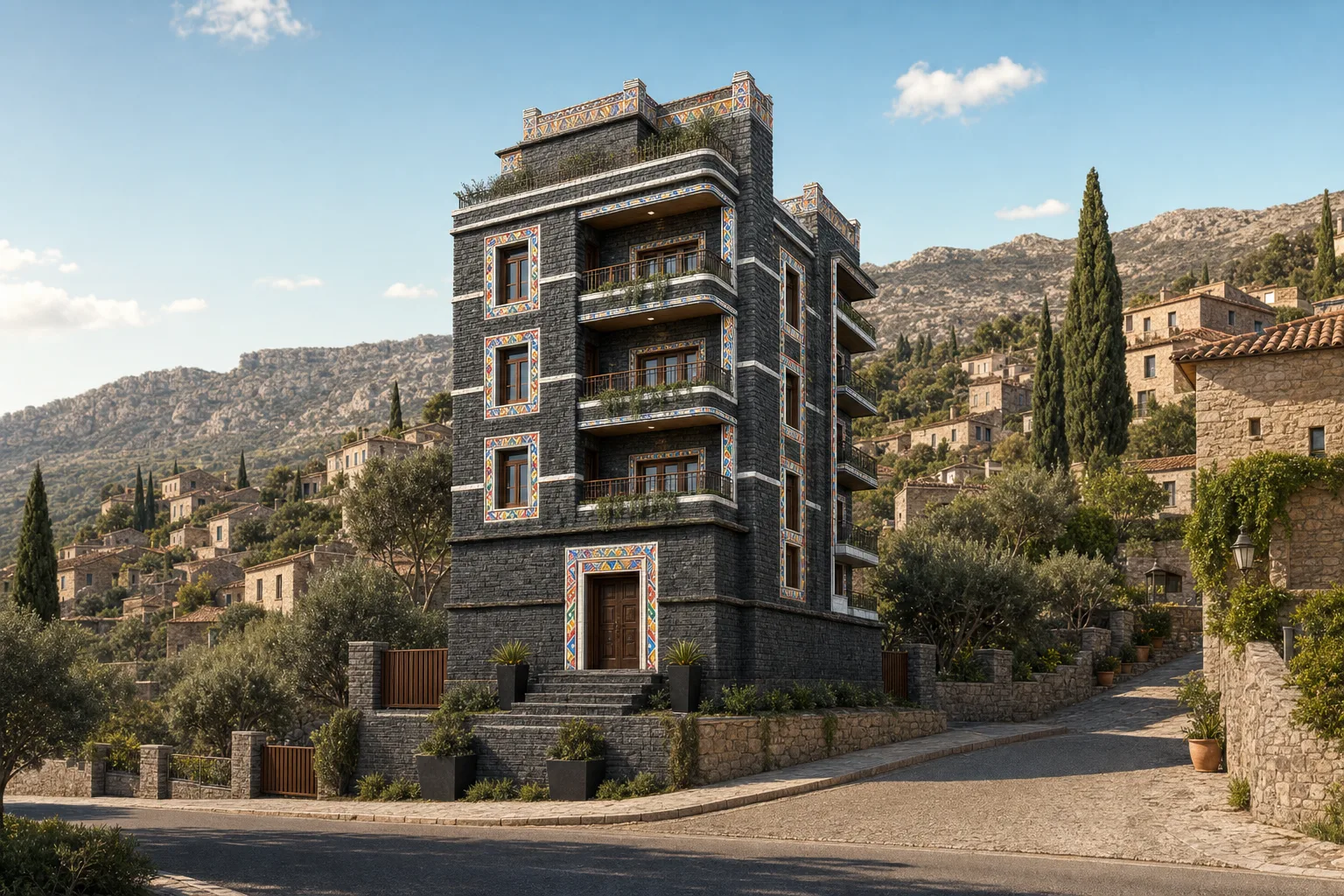
Terraced Stone Tower with Patterned Vernacular Facade
Architectural Topic
Terraced Stone Tower with Patterned Vernacular Facade is an architectural gallery study focused on exterior design, using contemporary minimal, exterior, monolithic volumes to explain the image as a practical reference for facade, massing, material, and spatial decisions.
Stylistically the project negotiates between a fortified, almost stereotomic tower typology and a vividly ornamented vernacular lineage. Dark, roughly coursed stonework anchors the mass as a continuous base, recalling traditional load-bearing envelopes, even if the actual structure is likely a contemporary frame. Against this heavy field, the polychrome geometric bands around every opening behave as both ornament and precise tectonic articulation, echoing regional craft traditions without lapsing into pastiche. The result is a building that operates somewhere between Mediterranean hill-town precedent and a more contemporary, compact apartment block.
The massing strategy is deliberately simple: a primary vertical volume is incised on two sides to carve stacked loggias, establishing a clear front–side hierarchy while preserving a monolithic street silhouette. Horizontal bands at each floor edge and parapet read as belt courses, tightening the proportion system and visually registering the floor plates. The double corner projections at roof level create a crenellated skyline outline, suggesting a watchtower memory while also framing usable roof gardens. This play of carved voids within a heavy figure sets up a legible rhythm of solid and recess that holds its own against the stepped topography behind.
Fenestration follows a disciplined grid, with vertically aligned window bays on the main facade and deeper balcony cuts on the side, producing a straightforward structural reading: column-and-slab logic masked by a stone cladding regime. Openings appear moderately recessed, increasing shadow depth and improving envelope performance for solar control, especially in a bright, likely Mediterranean climate. Continuous balcony bands with thin metal railings introduce visual permeability along the flanks, while the front remains more planar and emblematic. The colored border insets operate almost as a secondary frame, thickening the perceived wall and modulating light at the reveal through contrast rather than mechanical shading devices.
Materially, the project relies on a tight stratigraphy: dark stone cladding for the bulk of the envelope, lighter stone or concrete banding, timber or timber-look infill around balcony soffits and doors, and ceramic or painted plaster for the patterned panels. The contrast between the heavy, low-porosity masonry and the warm timber components suggests a conscious differentiation between structural-looking masses and inhabited thresholds. Textural variation is calibrated rather than exuberant: rough stone courses at the base, slightly finer jointing above, and smooth, brightly colored ornament as a thin, almost graphic layer on top. This thin-thick dialogue reinforces the sense of a robust core with more delicate, inhabitable edges.
Materials
The material reading is driven by mineral and stone-like tones, using surface depth, shadow, and warm neutral coloration to strengthen the facade's architectural identity.
Style
The style direction reads as contemporary minimal, supported by exterior and monolithic volumes.
View the Peloponnese Stone Tower & Village style guideBuilding Type
Apartment Building
Facade Logic
The facade logic uses arches, screens, and layered openings to balance cultural reference, shading depth, and contemporary envelope rhythm.
Explore Related Keywords
1536 × 1024 px
Generation Receipt
Deterministic pipeline: the workflow, style direction and output size below are locked at generation time, so the same inputs reproduce the same visual language.
- Workflow
- Toscape workflow
- Style direction
- Peloponnese Stone Tower & Village
- Output
- 1536 x 1024 px
More from this category


Academy links
Material Swap for Facades and Interiors
Study how material changes alter facade and interior perception.
Re-Render for Concept and Client Review
Learn how to refine existing concepts while protecting studio imagery.
Integrating Toscape into Architectural Production
Connect AI image studies with professional studio workflows.