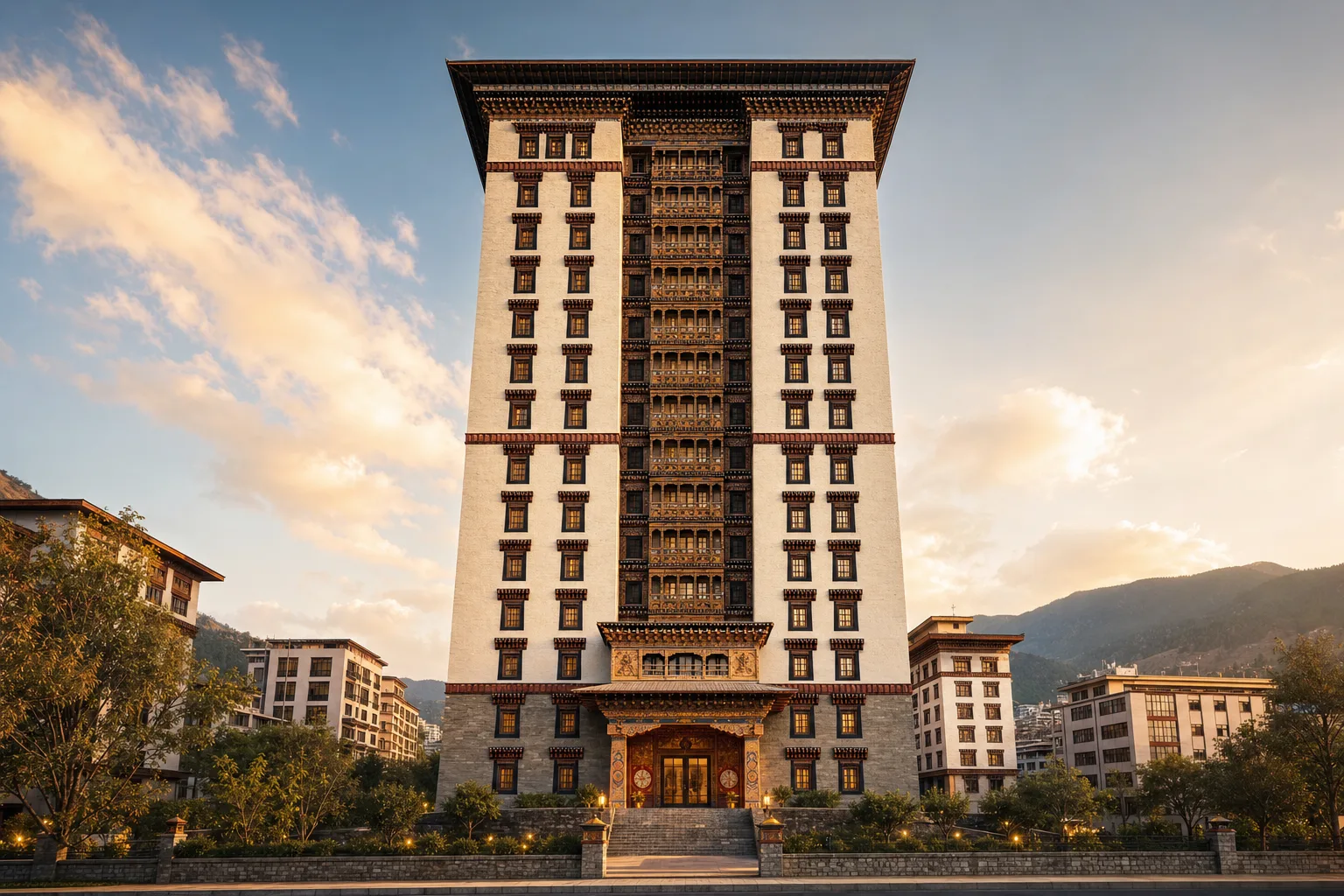
Vertical Dzong-Inspired Tower in Mountain City Fabric
Architectural Topic
Vertical Dzong-Inspired Tower in Mountain City Fabric is an architectural gallery study focused on exterior design, using nature-integrated contemporary, exterior, organic spatial flow to explain the image as a practical reference for facade, massing, material, and spatial decisions.
Stylistically, the composition extends the lineage of fortress-monastic architecture into a contemporary envelope, keeping the cultural silhouette while adjusting tectonics for height and urban density. The massing is essentially a prismatic slab, but the designers use a strong massing hierarchy: a thickened stone plinth, a tall shaft of white-rendered walls, and a deep, hovering roof datum that recalls traditional timber eaves magnified to metropolitan scale. Flanking lower buildings in the background echo the same grammar at reduced height, hinting at a larger precinct or planned ensemble where this tower acts as the dominant vertical marker in the skyline.
At the level of tectonics, the facade uses a clear interplay between stereotomic and tectonic registers. The stone-clad base reads as weight-bearing and earthbound, while the upper rendered surfaces operate as planar fields punctured by small, deeply recessed openings. These punctures are rhythmically organized into tight window clusters whose heavy timber surrounds perform both as shading devices and as a visual brise-soleil, thickening the envelope depth. The central vertical band of elaborately carved balconies and oriels intensifies this tectonic reading, forming a textured spine that concentrates ornament and suggests a privileged internal spatial sequence—perhaps lift lobbies and shared lounges stacked along the main axis.
Fenestration strategy is deliberately conservative in aperture size yet generous in repetition, balancing envelope performance with the high-altitude sun and strong daylight. Each window sits within a layered timber frame and projecting lintel, creating micro-canopies that control glare while amplifying shadow play; the resulting chiaroscuro gives the otherwise planar surfaces a granular relief under low-angle light. The deep crown roof, with its dark soffit and stacked brackets, functions as a climatic visor as much as a symbolic termination, sharply capping the vertical thrust and shading the uppermost level so that the tower’s silhouette remains crisp against the sky.
Materially, the building appears to work with a tripartite stratigraphy: rougher, cooler-toned stone at the base, warm-toned rendered or painted masonry in the tower shaft, and dark, likely hardwood elements at openings and eaves. While modern construction is almost certainly concrete-framed, the visual language keeps the load-reading cues traditional, allowing the viewer to intuit compression at the bottom and lighter, more crafted components aloft. Ornament concentrates where the body touches the ground and sky—entry portal and roof—leaving the intermediate fields relatively disciplined, which prevents the height from becoming visually chaotic and preserves a legible proportion system of base–shaft–capital.
Materials
The material reading is driven by mineral and stone-like tones, using surface depth, shadow, and warm neutral coloration to strengthen the facade's architectural identity.
Style
The style direction reads as nature-integrated contemporary, supported by exterior and organic spatial flow.
View the Atlas Mountain Berber Vernacular style guideBuilding Type
Hotel
Facade Logic
The facade logic is organized around organic or parametric articulation, where repeated surface movement creates a unified envelope rather than a flat decorative skin.
Explore Related Keywords
1536 × 1024 px
Generation Receipt
Deterministic pipeline: the workflow, style direction and output size below are locked at generation time, so the same inputs reproduce the same visual language.
- Workflow
- Toscape workflow
- Style direction
- Atlas Mountain Berber Vernacular
- Output
- 1536 x 1024 px
More from this category


Academy links
Material Swap for Facades and Interiors
Study how material changes alter facade and interior perception.
Re-Render for Concept and Client Review
Learn how to refine existing concepts while protecting studio imagery.
Integrating Toscape into Architectural Production
Connect AI image studies with professional studio workflows.