Austrian Tyrol Alpine Farmhouse
Austria · Tyrolean farmhouse (Tiroler Bauernhaus / Maso chiuso) of the Austrian Tyrol
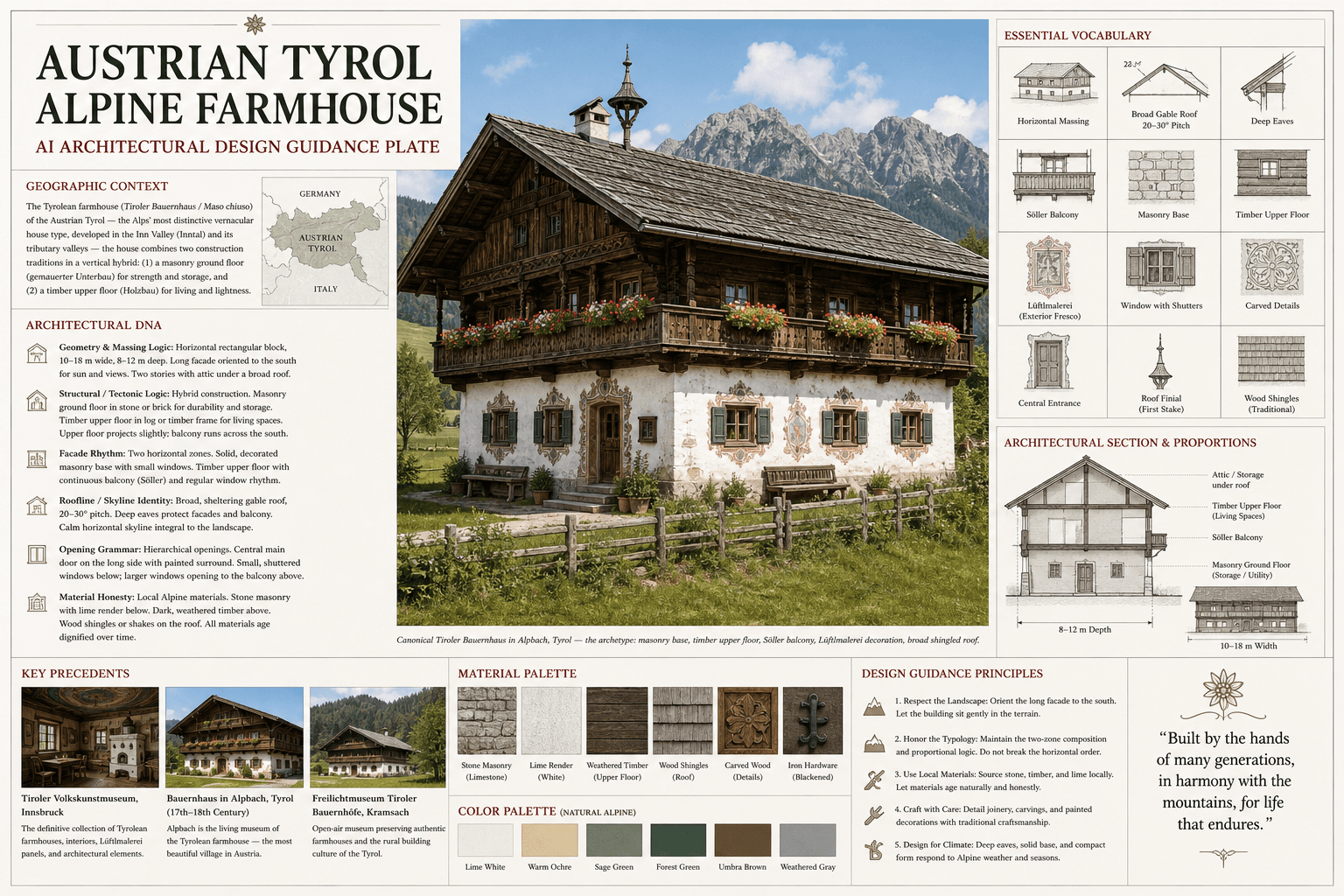
The Tyrolean Alpine farmhouse (Tiroler Bauernhaus) — a distinctive two-story stone-and-timber house of the Tyrol region, combining a whitewashed masonry ground floor (gemauert) wit...
Definition
Austrian Tyrol Alpine Farmhouse is a regional architectural identity from Austria. The Tyrolean Alpine farmhouse (Tiroler Bauernhaus) — a distinctive two-story stone-and-timber house of the Tyrol region, combining a whitewashed masonry ground floor (gemauert) wit.
- Country
- Austria
- Region
- Tyrolean farmhouse (Tiroler Bauernhaus / Maso chiuso) of the Austrian Tyrol.
- Massing
- The Tyrolean farmhouse is a horizontal rectangular block, its long facade oriented toward the sun.
- Materials
- Materials are local Alpine — stone, timber, lime: (1) Stone masonry — local Alpine limestone or metamorphic rock.
- Palette
- White, cream, pale sand, warm timber, and shadow-driven dark metal accents define the palette.
- Climate response
- The Tyrolean Inn Valley has an Alpine continental climate: (1) Warm summers (20–30°C) with intense solar radiation at altitude — the white rendered walls reflect heat.
Try it free
Render your own project in this style
Upload one photo of your own project and Re-Render keeps the geometry and camera while carrying the Austrian Tyrol Alpine Farmhouse language into materials, proportion, and detail. Three free renders, no account needed.
Open Re-Render - freeOverview
Austrian Tyrol Alpine Farmhouse is a regional architectural identity in Austria. The Tyrolean farmhouse (Tiroler Bauernhaus / Maso chiuso) of the Austrian Tyrol — the Alps' most distinctive vernacular house type, developed in the Inn Valley (Inntal) and its tributary valleys — the house combines two construction traditions in a vertical hybrid: (1) a masonry ground floor (gemauerter Sockel — stone or brick, rendered and whitewashed), containing the kitchen (Kuchl), the parlor (Stube — the main li...
Visual DNA
Massing & Form
The Tyrolean farmhouse is a horizontal rectangular block, its long facade oriented toward the sun. The proportions emphasize breadth over height — the house spreads across the mountain slope, anchored to the terrain.
Facade Language
The facade (typically the south-facing long side or the gable end) is organized in two clear horizontal zones: (1) The masonry ground floor — white rendered wall with small, regularly-spaced windows (0.8–1.2 m wide, 1–1.5 m high), each with dark green or brown louvered shutters (Fensterläden) — the Lüftlmalerei painted...
Materials & Texture
Materials are local Alpine — stone, timber, lime: (1) Stone masonry — local Alpine limestone or metamorphic rock, rendered with lime plaster (Kalkputz) and whitewashed — the white surface reflects summer heat and creates a bright landmark in the winter landscape. (2) Timber — spruce (Fichte) or larch (Lärche) logs for...
Color Palette
White, cream, pale sand, warm timber, and shadow-driven dark metal accents define the palette. The facade should stay bright and climate-aware rather than heavy, gray, or over-saturated.
Ornament & Detail
The Lüftlmalerei is the Tyrolean house's most distinctive ornamental expression — a Baroque folk art of illusionistic architectural painting: (1) Window surrounds — painted trompe-l'œil pediments, pilasters, and brackets framing each window — creating the illusion of a richer architectural order than the actual structu...
Climate Response
The Tyrolean Inn Valley has an Alpine continental climate: (1) Warm summers (20–30°C) with intense solar radiation at altitude — the white rendered walls reflect heat; the deep roof eaves shade the walls and windows; the Söller balcony provides shaded outdoor living space. (2) Cold winters (-10°C to -20°C) with moderat...
Landscape & Ground
The Tyrolean farmhouse (Tiroler Bauernhaus / Maso chiuso) of the Austrian Tyrol — the Alps' most distinctive vernacular house type, developed in the Inn Valley (Inntal) and its tributary valleys — the house combines two construction traditions in a vertical hybrid: (1) a masonry ground floor (gemauerter Sockel — stone...
Reference elevation
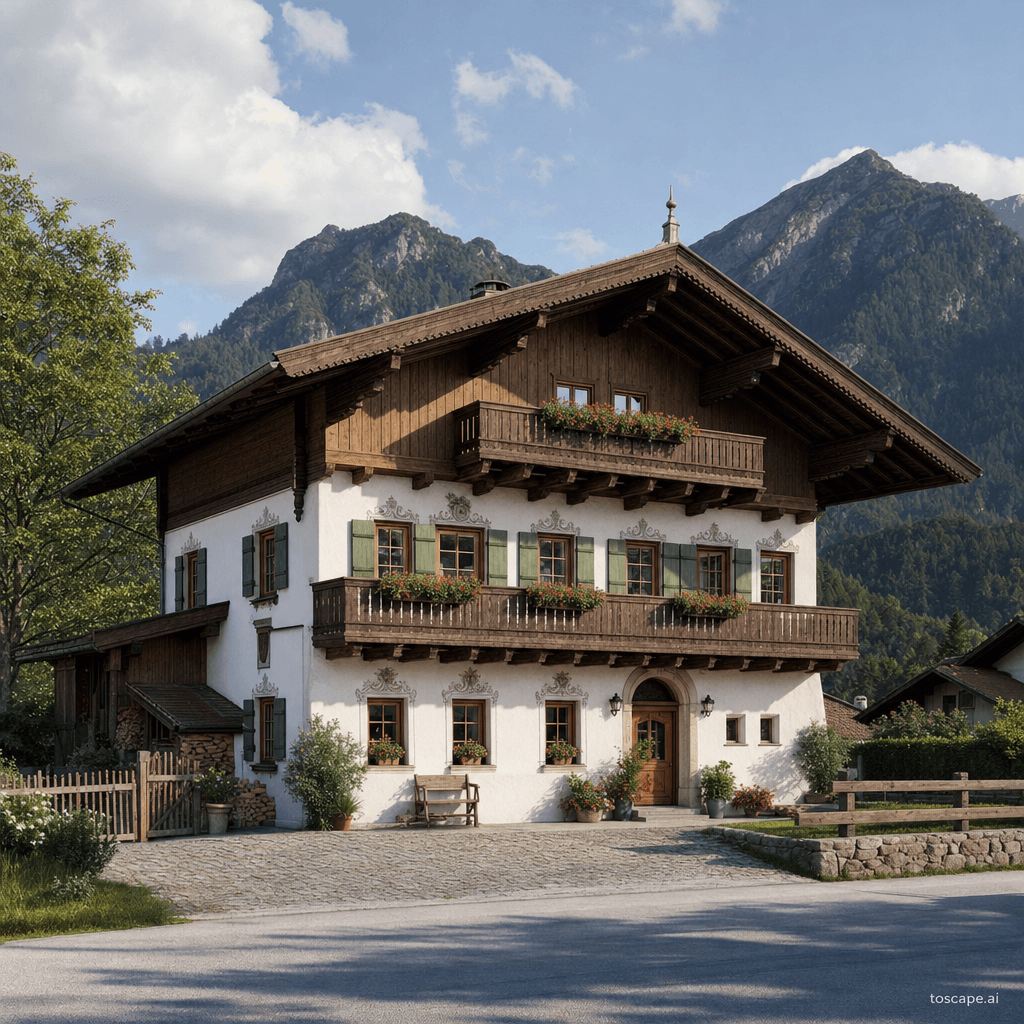
Austrian Tyrol Alpine Farmhouse — characteristic facade composition, Tyrolean farmhouse (Tiroler Bauernhaus / Maso chiuso) of the Austrian Tyrol.
Context Snapshot
The Tyrolean farmhouse (Tiroler Bauernhaus / Maso chiuso) of the Austrian Tyrol — the Alps' most distinctive vernacular house type, developed in the Inn Valley (Inntal) and its tributary valleys — the... The Tyrolean Inn Valley has an Alpine continental climate: (1) Warm summers (20–30°C) with intense solar radiation at altitude — the white rendered walls reflect heat; the deep roof eaves shade the walls and windows; the...
Contemporary Relevance
Austrian Tyrol Alpine Farmhouse is useful today for residential, hospitality, civic, and place-branding work that needs Austria-specific character grounded in local massing, material tone, climate response, and settlement logic rather than generic international styling.
Use this style in Toscape
Explore Austrian Tyrol Alpine Farmhouse directly inside Toscape using the Facade Re-Style and Design Options workflows.
Open Austrian Tyrol Alpine Farmhouse in the galleryFrequently asked questions
What is Austrian Tyrol Alpine Farmhouse?
Austrian Tyrol Alpine Farmhouse is a regional architectural identity from Austria. The Tyrolean Alpine farmhouse (Tiroler Bauernhaus) — a distinctive two-story stone-and-timber house of the Tyrol region, combining a whitewashed masonry ground floor (gemauert) wit.
What materials define Austrian Tyrol Alpine Farmhouse?
Materials are local Alpine — stone, timber, lime: (1) Stone masonry — local Alpine limestone or metamorphic rock.
What is the Austrian Tyrol Alpine Farmhouse color palette?
White, cream, pale sand, warm timber, and shadow-driven dark metal accents define the palette. The facade should stay bright and climate-aware rather than heavy, gray, or over-saturated.
Where does Austrian Tyrol Alpine Farmhouse come from?
The Tyrolean farmhouse (Tiroler Bauernhaus / Maso chiuso) of the Austrian Tyrol — the Alps' most distinctive vernacular house type.
When should architects use Austrian Tyrol Alpine Farmhouse?
Austrian Tyrol Alpine Farmhouse is useful today for residential, hospitality, civic, and place-branding work that needs Austria-specific character grounded in local massing, material tone, climate response, and settlement logic rather than generic international styling.
How do you render Austrian Tyrol Alpine Farmhouse in Toscape?
Toscape renders your own photograph, elevation, sketch, or CAD view through the Austrian Tyrol Alpine Farmhouse reference. The Facade Re-Style and Design Options workflows keep the building's geometry and camera fixed while the surface language shifts toward Austrian Tyrol Alpine Farmhouse.
Other regional identities from Austria
- Austrian Vorarlberg Wooden HouseThe Vorarlberg wooden house (Vorarlberger Holzhaus / Wälderhaus) of the Bregenzerwald region — a distinctive timber.
- Austrian Salzburg TownhouseThe Salzburg burgher townhouse (Salzburger Bürgerhaus) — a Baroque urban house of the prince-archbishopric city.
- Austrian Styria Wine-Country Courtyard HouseThe Styrian wine-country farmhouse (Steirisches Bauernhaus / Vierseithof) of southern Austria — a distinctive four-sided courtyard.
- Austrian Vienna Secession TownhouseThe Vienna Secession and Jugendstil apartment house (Wiener Miethaus / Zinshaus) — the urban architecture.