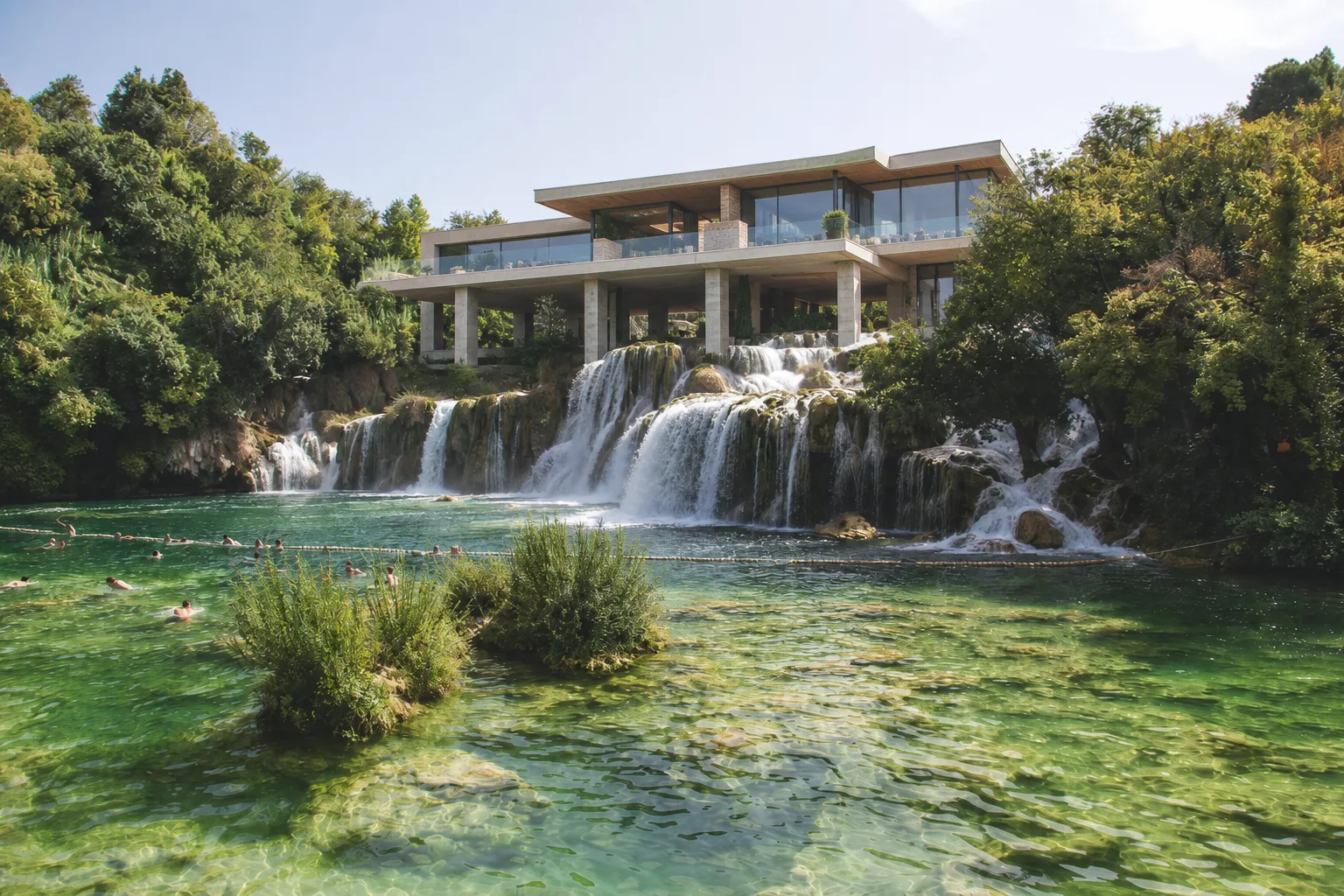
Cliffside Pavilion Above the Waterfalls
Architectural Topic
Cliffside Pavilion Above the Waterfalls is an architectural gallery study focused on exterior design, using nature-integrated contemporary, exterior, organic spatial flow to explain the image as a practical reference for facade, massing, material, and spatial decisions.
Formally, the work aligns with a late-modern lineage that blends Miesian planar roofs with a kind of Brazilian-influenced exuberance toward landscape. Two dominant horizontal datum lines—the ultra-thin roof slab and the thickened terrace plate below—float over a field of slender columns and stone-clad cores, establishing a clear massing hierarchy: landscape as stereotomic base, concrete deck as intermediate datum, and glazed volume as the light crown. The structural rhythm is legible but not overly gridded; column spacing responds both to span and to view corridors, allowing large bays of uninterrupted glass where the main interior spaces likely sit.
The tectonic expression hinges on a deliberate contrast between the heavy, erosive logic of the rock and the dry, rectilinear precision of the superstructure. While the waterfall reads as a carved, geologic mass, the building resists any mimicry of that fluid form, instead hovering as an abstract frame. Load-reading is unusually explicit: vertical forces appear to flow through the robust terrace slab into a forest of columns that step back from the water’s edge, so the cantilevered portions intensify the sensation of being suspended above the cascades. This creates a layered spatial sequence—from swimmers in the pool to the spray-laden rock shelf, then the shaded stoa under the deck, and finally the glazed rooms and roof terrace above.
Envelope logic is almost entirely about visual permeability and atmospheric modulation. Floor-to-ceiling glazing spans long distances, occasionally bracketed by narrow stone piers that thicken the facade and temper pure transparency. Roof overhangs project far enough to suggest credible solar shading in this latitude, while the deep terrace slab operates as a horizontal brise-soleil for any program tucked beneath it. Where solid wall surfaces occur, they appear in a warm, possibly limestone or sandstone cladding, whose rougher texture negotiates between the crispness of the concrete frame and the vegetated hillside, setting up a quiet material stratigraphy from wet rock to dressed stone to smooth structural surfaces.
Light and shadow are used here less as heroic devices and more as environmental regulators. The underside of the terrace becomes a cool, shaded loggia overlooking the turbulent water, a liminal zone where spray, sound, and filtered daylight produce a dense sensorial field. Above, the thin roof slab casts a stable shadow band along the glass, reducing glare and allowing interior spaces to remain visually open without constant screening. Reflections of water on the soffits and glass introduce a moving, rippled light that destabilizes the otherwise rigid geometry and makes the architecture feel less static, more in dialogue with the hydrologic cycle beneath it. Experientially, the building choreographs proximity and distance to the landscape rather than trying to disappear into it. One moves from immersion in the green, slow-moving pool at the foreground, through the roar of the falls, to a seemingly weightless terrace that extends over the void, and finally into a controlled interior climate still visually tied to the riverine scene. Its contemporaneity lies not just in the thin slabs and curtain wall detailing, but in the unapologetic occupation of a dramatic site while still foregrounding the performative role of shade, breeze, and view. In a future where concept-to-facade workflows may be iterated rapidly through platforms such as https://www.toscape.ai/—especially for this kind of landscape-intense, view-driven resort typology—the critical task will be preserving this level of tectonic clarity and contextual specificity within increasingly fluid digital design processes.
Materials
The material reading is driven by mineral and stone-like tones, using surface depth, shadow, and warm neutral coloration to strengthen the facade's architectural identity.
Style
The style direction reads as nature-integrated contemporary, supported by exterior and organic spatial flow.
Explore Regional & Global StylesBuilding Type
Resort
Facade Logic
The facade logic is organized around organic or parametric articulation, where repeated surface movement creates a unified envelope rather than a flat decorative skin.
Explore Related Keywords
1536 × 1024 px
Generation Receipt
Deterministic pipeline: the workflow, style direction and output size below are locked at generation time, so the same inputs reproduce the same visual language.
- Workflow
- Toscape workflow
- Style direction
- Explore Regional & Global Styles
- Output
- 1536 x 1024 px
More from this category


Academy links
Material Swap for Facades and Interiors
Study how material changes alter facade and interior perception.
Re-Render for Concept and Client Review
Learn how to refine existing concepts while protecting studio imagery.
Integrating Toscape into Architectural Production
Connect AI image studies with professional studio workflows.