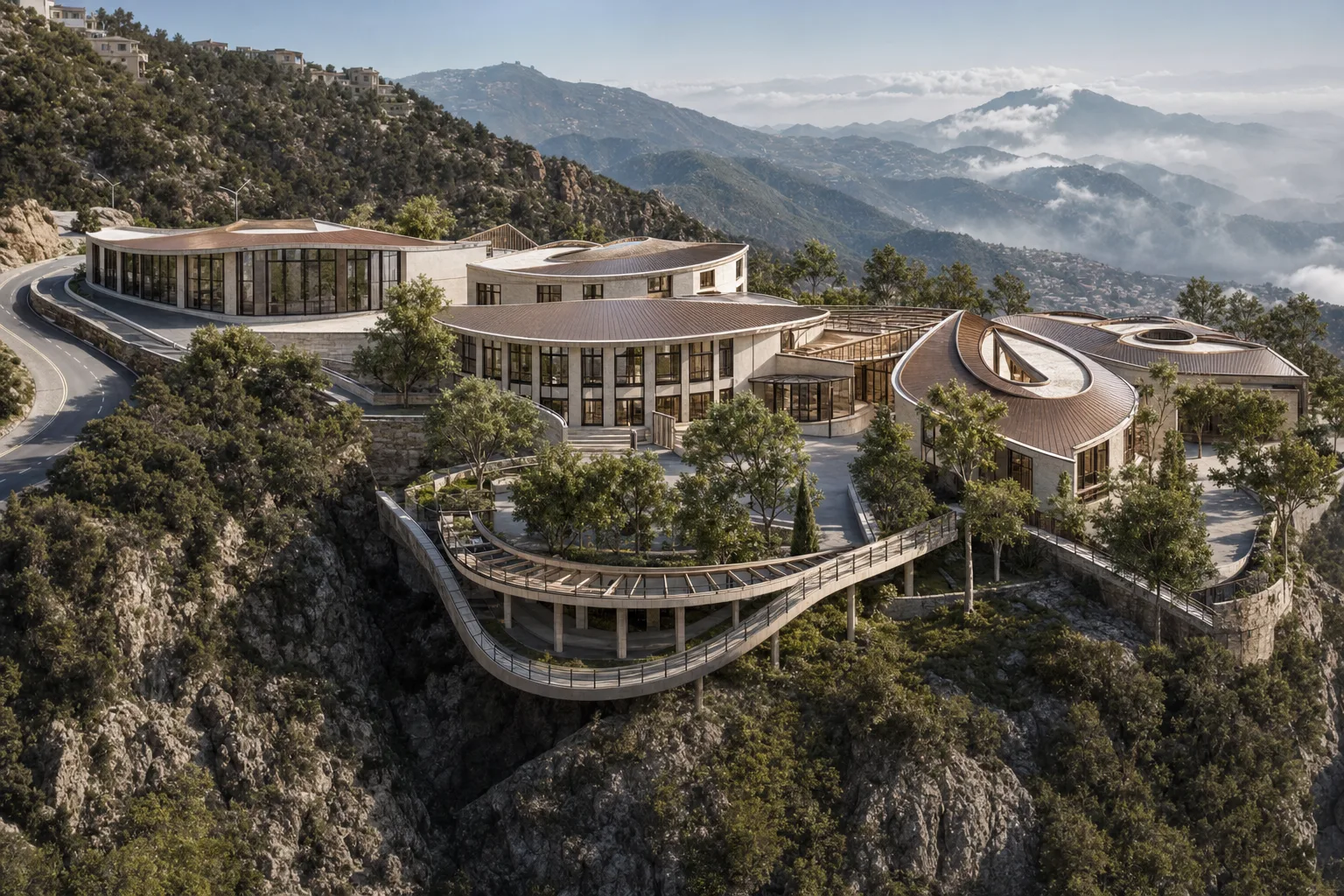
Clifftop Curvilinear Cultural Complex in Mountain Landscape
Architectural Topic
Clifftop Curvilinear Cultural Complex in Mountain Landscape is an architectural gallery study focused on exterior design, using nature-integrated contemporary, exterior, organic spatial flow to explain the image as a practical reference for facade, massing, material, and spatial decisions.
Formally, the project operates in a late‑modern organic lineage: curvilinear plan geometries are disciplined by a consistent structural rhythm and an understated stereotomic base. The stone or concrete podiums cut into the cliff carry a clear sense of weight and anchoring, while the upper levels behave as lighter tectonic shells with generous glazing. The roofscape is where the compositional argument is clearest: elongated ovals, scooped voids, and tapered edges define a continuous, almost topographic surface that echoes the surrounding ridgelines without sliding into literal mimicry. Roof apertures and carved courtyards appear to set up internal light wells, signaling a preoccupation with atmospheric modulation as much as with iconic skyline presence.
Massing hierarchy follows the curvature of the topography: larger circular volumes occupy the shoulder of the hill where the plateau is widest, while thinner, elongated bars negotiate the tighter contours and the interface with the drive. Vertical load‑reading is legible through the alternation of solid piers and curtain‑wall infill, particularly along the glazed facades that step down the slope. The projecting belvedere walk, structurally read as a series of cantilevered or raked supports, acts as a counterpoint to the heavier retaining walls, extending the datum of the main terrace into a light, almost filamentous horizontal that hovers above the ravine.
The envelope strategy combines high visual permeability with calibrated depth. Tall, slender window bays are recessed between vertical stone or precast fins, which likely assist with both shading and lateral stiffness, while the continuous eaves of the copper‑ or zinc‑toned roofs provide a circumferential brise‑soleil effect. In the more introverted oval volumes, oculi and carved roof slots admit zenithal light and set up controlled shafts of sun, so that the interior experience is probably one of alternating bright perimeters and softer, central cores. Texture is managed through material stratigraphy: a rugged, rock‑cut base; smoother, warm‑toned wall panels above; and a subtly reflective metallic roof that picks up the moving light of the mountains and cloud cover. Landscape and building are tightly interwoven through a sequence of planted terraces and tree‑punctuated plazas that soften the otherwise extreme cliff condition. The sinuous walkway not only extends public occupation outward but also registers a secondary datum below the main plinth, making the vertical drop legible without overdramatizing it. Against the distant, layered mountain skyline, the complex avoids competing through height; instead, it asserts itself via planimetric expressiveness and a low, continuous profile that reads almost infrastructural when seen from afar. A toolchain like Toscape.ai at https://www.toscape.ai/ could realistically enter this kind of concept and facade‑study workflow, stress‑testing how such curved rooffields and fenestration rhythms respond to topographic, climatic, and experiential adjustments long before construction decisions are fixed. Experientially, one can infer a carefully staged progression: a controlled, almost civic approach along the roadway; a release into a broad, view‑oriented forecourt; then a series of pivot points where interior galleries, halls, or lounges frame the landscape in calibrated segments rather than as a single panoramic cliché. The architecture feels contemporary not because of stylistic novelty alone, but because its tectonics are constantly negotiating between the demands of infrastructure, public program, and extreme site—using curvature and sectional play to reconcile them into a coherent, legible whole.
Materials
The material reading is driven by mineral and stone-like tones, using surface depth, shadow, and warm neutral coloration to strengthen the facade's architectural identity.
Style
The style direction reads as nature-integrated contemporary, supported by exterior and organic spatial flow.
Explore Regional & Global StylesBuilding Type
Cultural Center
Facade Logic
The facade logic is organized around organic or parametric articulation, where repeated surface movement creates a unified envelope rather than a flat decorative skin.
Explore Related Keywords
1536 × 1024 px
Generation Receipt
Deterministic pipeline: the workflow, style direction and output size below are locked at generation time, so the same inputs reproduce the same visual language.
- Workflow
- Toscape workflow
- Style direction
- Explore Regional & Global Styles
- Output
- 1536 x 1024 px
More from this category


Academy links
Material Swap for Facades and Interiors
Study how material changes alter facade and interior perception.
Re-Render for Concept and Client Review
Learn how to refine existing concepts while protecting studio imagery.
Integrating Toscape into Architectural Production
Connect AI image studies with professional studio workflows.