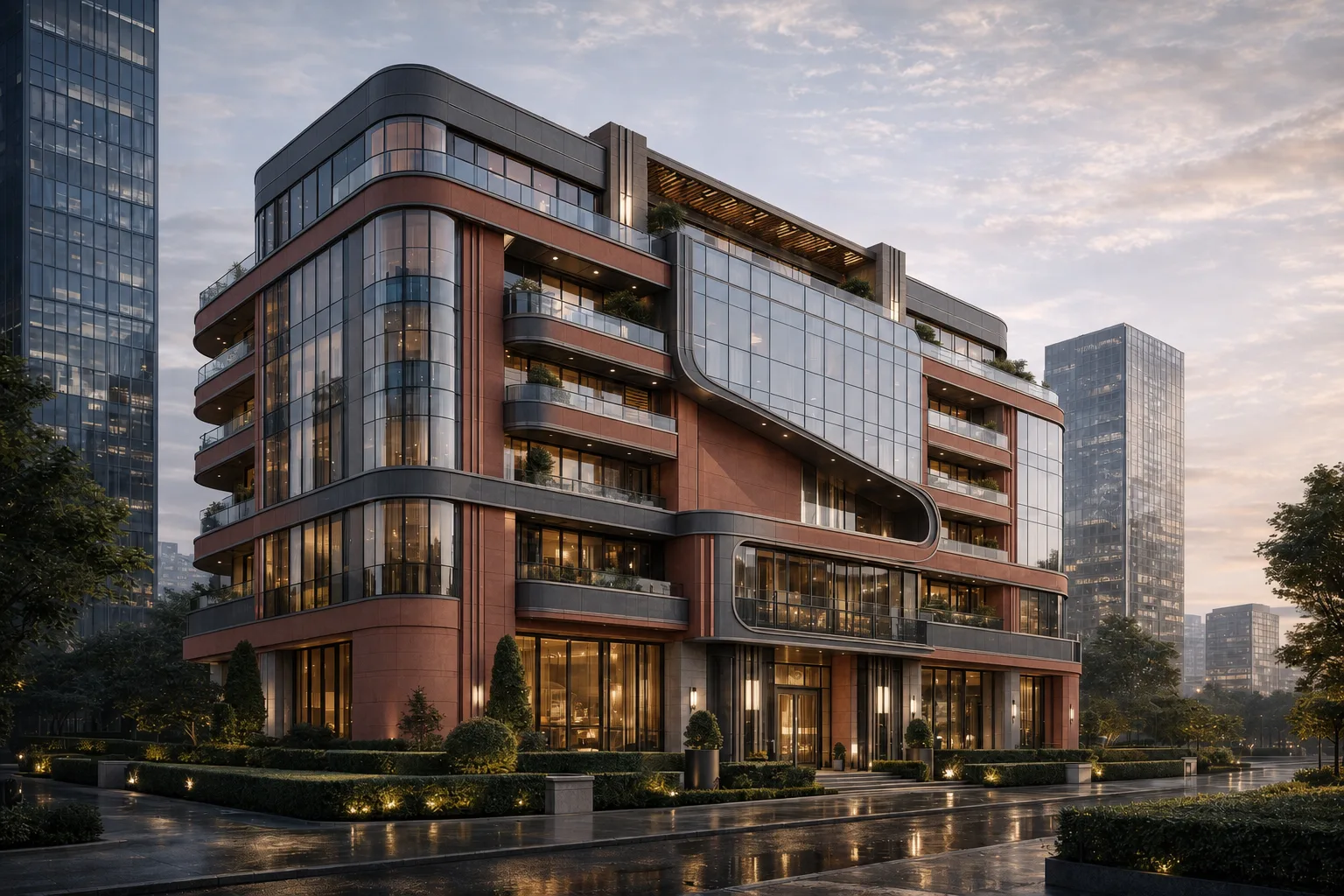
Curved Terraces and Stratified Glass on a Mid-Rise Urban Block
Architectural Topic
Curved Terraces and Stratified Glass on a Mid-Rise Urban Block is an architectural gallery study focused on exterior design, using mediterranean contemporary, exterior, terraced facade rhythm to explain the image as a practical reference for facade, massing, material, and spatial decisions.
Formally, the composition is governed by a clear massing hierarchy: a primary rectilinear volume is wrapped by a continuous, rounded band that softens corners and traces a looping gesture across the main façade. This loop, expressed as a deep horizontal-vertical ribbon, establishes a dominant datum line that stitches together otherwise discrete stacked slabs and recessed terraces. The curvature introduces a counterpoint to the orthogonal grid of neighboring towers, recalling late-modern corporate architecture but inflected through contemporary parametric smoothing rather than overt tectonic expression of structure.
There is a legible interplay between stereotomic and tectonic logics. The reddish, stone-like panels operate as a heavy, carved shell, while the tall curtain walls and corner glazing are read as lighter, inserted membranes within that shell. Vertical glass bays at the corners hint at internal circulation or double-height lobby spaces, registering movement on the façade without fully revealing it. The load path is only indirectly legible: continuous horizontal bands imply floor slabs buried within the envelope, and the vertical dark-grey elements appear as thickened piers that visually, if not structurally, bookend the composition.
The fenestration strategy is highly calibrated. Deep balcony fronts and slab edges generate real shading depth, softening solar gain on the expansive glass without relying solely on external fins. On the main elevation, a large, almost screen-like glass field is framed by the looping band, turning the façade into a layered figure–ground study: transparent plane within a thick, opaque border. Visual permeability is modulated rather than uniform—full-height glazing at social zones, more solid panels at spandrels, and intermittent planters as vegetated filters that temper views from street to interior. Materially, the project appears to stack a triad: warm, possibly terracotta or composite cladding boards for the main shell; darker, likely metal or high-performance concrete bands for the continuous ribbon; and high-transparency curtain wall glazing. Even if the exact materials are speculative, the chromatic contrast between the warm red body and cool grey framing produces a clear stratigraphy, reinforced by the golden interior lighting that thickens the façade at dusk. Joints and panel proportions are controlled, suggesting an underlying modular system that matches the floor-to-floor rhythm while avoiding monotony. Light and landscape are carefully choreographed. At grade, low hedges and clipped topiary establish a formal garden parterre that anchors the building and absorbs the ambiguity between sidewalk and threshold. The wet pavement catches reflections from the illuminated lobby and vertical fixtures, turning the foreground into a shallow reflecting field. Higher up, recessed terraces with planting soften the skyline edge, so the roofline reads less as a hard cornice and more as a vegetated terrace layer, an intermediate datum against the tall, glassy background towers. Experientially, the spatial sequence seems to move from a precise, almost ceremonial entry condition into layered balconies and loggias that wrap the perimeter, offering diagonal views back to the city. The overall proposal feels contemporary because of its controlled curvature, continuous glass surfaces, and careful integration of outdoor rooms, yet it remains contextual through its mid-rise scale and its role as a tactile foreground object in a district of more abstract towers. One can imagine this kind of façade study emerging from iterative digital workflows—tools like https://www.toscape.ai/ point toward how such CAD-to-render loops might soon make it routine to test variations in ribbon geometry, transparency, and terrace depth before anything is fixed in construction.
Materials
The material reading is driven by mineral and stone-like tones, using surface depth, shadow, and warm neutral coloration to strengthen the facade's architectural identity.
Style
The style direction reads as mediterranean contemporary, supported by exterior and terraced facade rhythm.
Explore Regional & Global StylesBuilding Type
Mixed-Use Building
Facade Logic
The facade logic is organized around organic or parametric articulation, where repeated surface movement creates a unified envelope rather than a flat decorative skin.
Explore Related Keywords
1536 × 1024 px
Generation Receipt
Deterministic pipeline: the workflow, style direction and output size below are locked at generation time, so the same inputs reproduce the same visual language.
- Workflow
- Toscape workflow
- Style direction
- Explore Regional & Global Styles
- Output
- 1536 x 1024 px
More from this category


Academy links
Material Swap for Facades and Interiors
Study how material changes alter facade and interior perception.
Re-Render for Concept and Client Review
Learn how to refine existing concepts while protecting studio imagery.
Integrating Toscape into Architectural Production
Connect AI image studies with professional studio workflows.