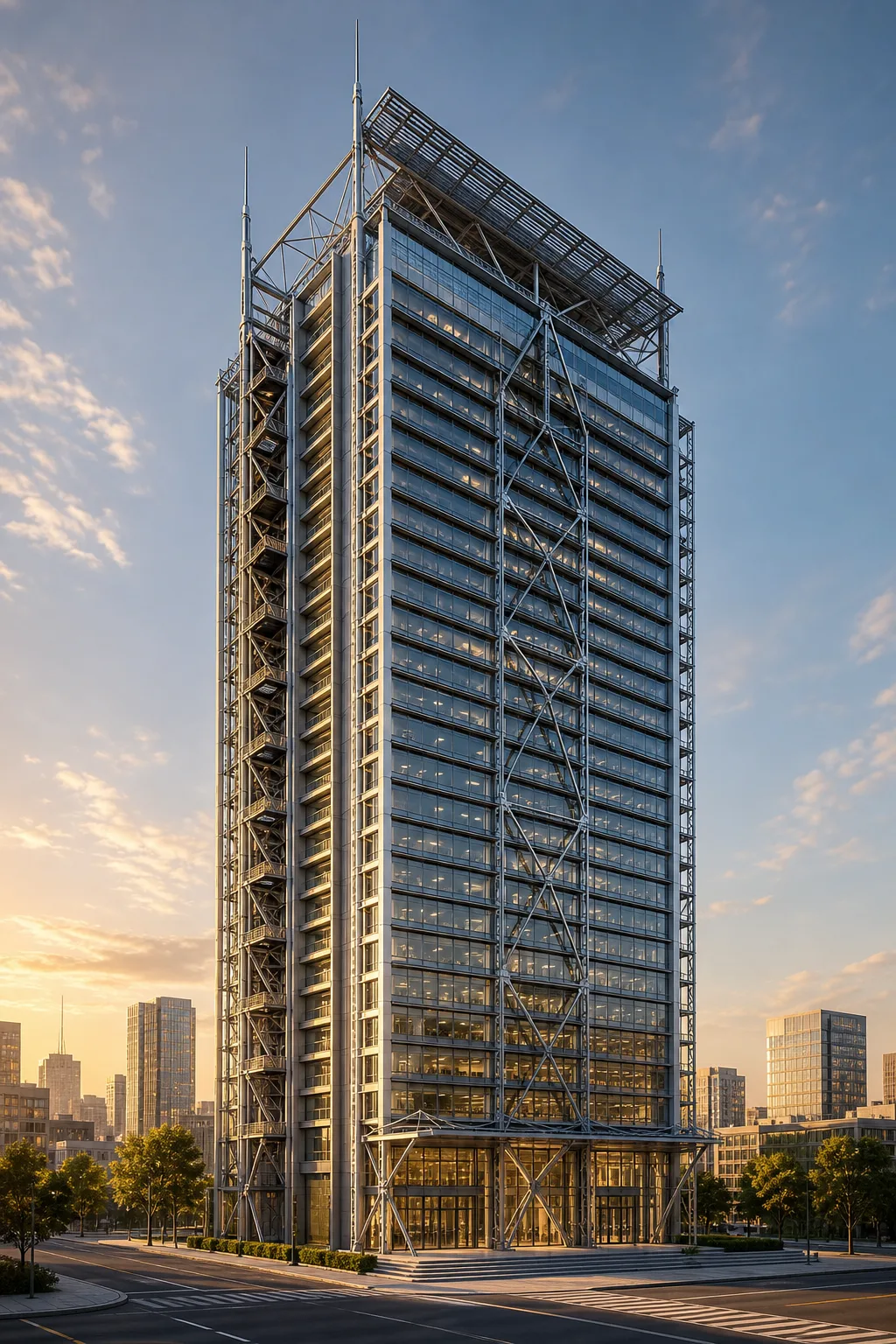
Exposed Steel High-Rise with Diagrid Bracing and Solar Crown
Architectural Topic
Exposed Steel High-Rise with Diagrid Bracing and Solar Crown is an architectural gallery study focused on exterior design, using contemporary fusion, exterior, balanced massing to explain the image as a practical reference for facade, massing, material, and spatial decisions.
Formally, the project sits somewhere between late high-tech and contemporary commercial pragmatism. The massing is essentially a single slender prism; what gives it character is the stereotomic–tectonic tension between the pure volume of glass and the extruded steel armature that climbs its flanks. Cross-bracing, exposed service catwalks, and the rooftop lattice recall the lineage of Richard Rogers and SOM’s structural exhibitionism, yet the detailing is more controlled and diagrammatic than exuberant. This is not parametric formalism; it is a rationalist tower whose silhouette is sharpened by a few key tectonic gestures—corner masts, a solar canopy, and rigorously spaced horizontal bands.
Conceptually, the building reads as an essay in structural legibility and environmental instrumentation. The exoskeleton is not merely decorative: the diagonals and belt trusses form a clear lateral-load narrative, pulled outward where they can be read by the city. At the same time, the layered façade hints at a performance-aware envelope: full-height glazing is buffered by external frames that can host walkways, shading devices, or maintenance tracks, allowing the thermal line to slip inward while the expressive steel remains outside. That duality between climatic skin and civic mask underpins the spatial philosophy, aligning workplace transparency with a robust urban presence.
The massing strategy is almost stubbornly singular, yet subtle hierarchy emerges. A podium is only faintly suggested by the slightly recessed, double-height entrance zone; the main datum is instead vertical, established by the continuous outer columns and diagonals that run nearly the full height. The tower culminates in a pronounced rooftop crown—a planar solar or maintenance canopy—creating a clear top to the composition and a secondary datum in the skyline. The interplay of verticals and diagonals lets the eye read load paths up the façade, while the long horizontal floor bands articulate the actual stacking of occupied space, a classic high-tech move that fuses structural diagram and occupancy diagram.
Fenestration is handled as a disciplined curtain-wall grid with high visual permeability, punctuated by denser structural stitching at the corners and along the service spine. Depth is created not by deep overhangs but by the multi-layered steel lattice, which casts shifting linear shadows across the glazing as the sun moves. On the east-facing side visible here, morning light rakes across the exoskeleton, thickening its apparent section and turning what could have been a flat glass slab into a three-dimensional instrument for catching light. At street level, slimmer columns and a lighter canopy structure scale the tectonic language down to the pedestrian, creating a finer-grain screen between interior lobby and tree-lined sidewalks.
Materials
The material reading is driven by mineral and stone-like tones, using surface depth, shadow, and warm neutral coloration to strengthen the facade's architectural identity.
Style
The style direction reads as contemporary fusion, supported by exterior and balanced massing.
View the High Tech style guideBuilding Type
Office Tower
Facade Logic
The facade logic is organized around organic or parametric articulation, where repeated surface movement creates a unified envelope rather than a flat decorative skin.
Explore Related Keywords
1024 × 1536 px
Generation Receipt
Deterministic pipeline: the workflow, style direction and output size below are locked at generation time, so the same inputs reproduce the same visual language.
- Workflow
- Toscape workflow
- Style direction
- High Tech
- Output
- 1024 x 1536 px
More from this category


Academy links
Material Swap for Facades and Interiors
Study how material changes alter facade and interior perception.
Re-Render for Concept and Client Review
Learn how to refine existing concepts while protecting studio imagery.
Integrating Toscape into Architectural Production
Connect AI image studies with professional studio workflows.