Hybrid Courtyard Tower with Neo-Classical East Asian Tectonics
Architectural Topic
Hybrid Courtyard Tower with Neo-Classical East Asian Tectonics is an architectural gallery study focused on exterior design, using contemporary minimal, exterior, monolithic volumes to explain the image as a practical reference for facade, massing, material, and spatial decisions.
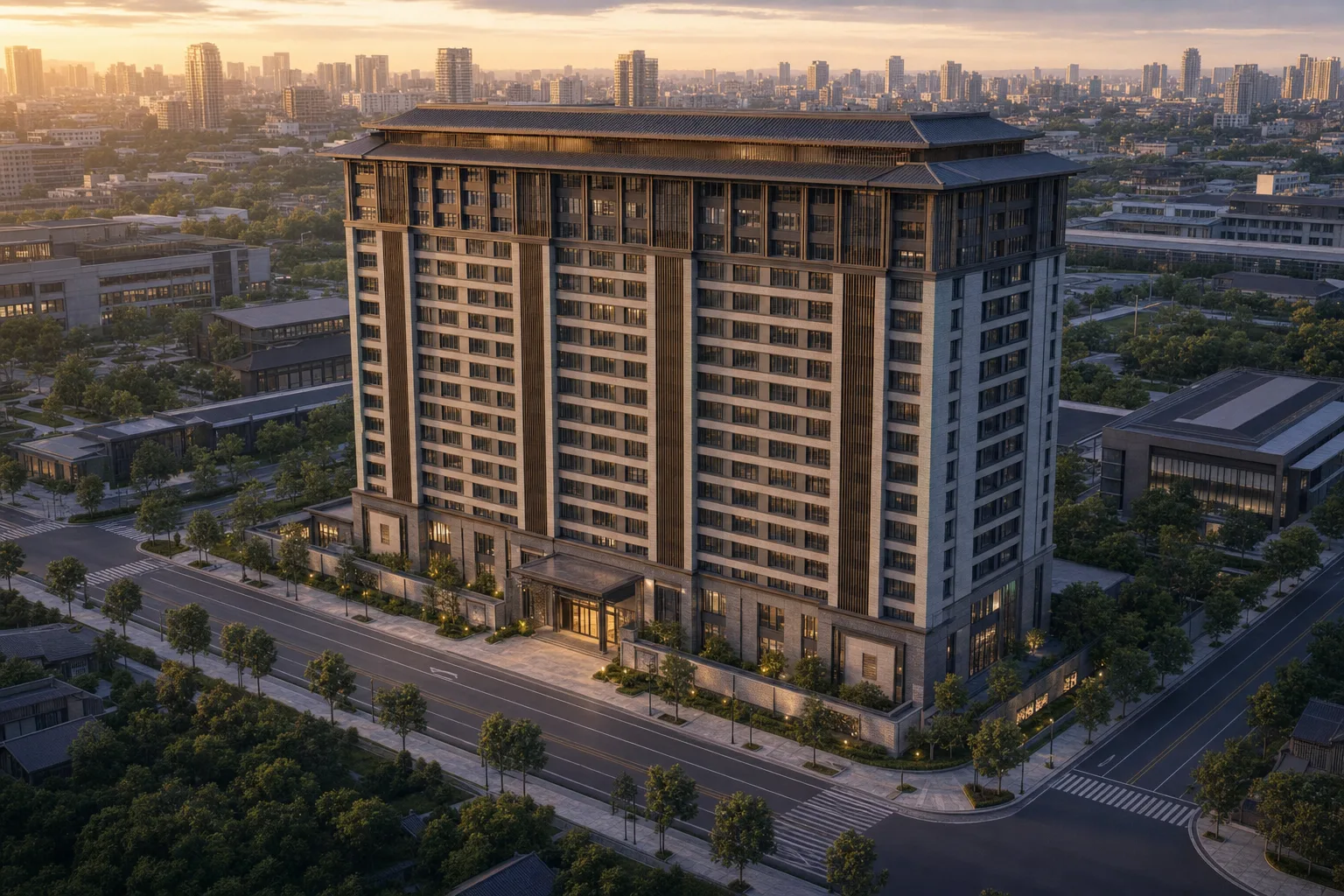
Stylistically, the project sits in a lineage of contemporary East Asian classicism, reworking traditional palace roof silhouettes and courtyard proportions into a mid-rise slab. The broad, overhanging roof with its layered eaves and dark fascia recalls timber bracket sets, abstracted here as planar cornices and slim columns. This is not literal historicism; rather, the façade composes a restrained tripartite order—base, shaft, crown—using a limited palette of stone-toned cladding and bronze-colored metal to maintain a calm, institutional presence amid the wider cityscape. The massing hierarchy emphasizes the roof as datum, visually compressing the floors below into a coherent, almost monolithic block.
Formally, the tower is a thickened bar, its long elevation broken into four primary bays by pronounced vertical pilasters that run uninterrupted from podium to cornice. These pilasters act as both visual stiffeners and devices of proportion, giving the otherwise repetitive housing grid a legible structural cadence. Horizontal bands—spandrels, slab edges, and continuous sill lines—temper that verticality, setting up a quiet interplay between stacked plates and framing ribs. One reads a clear gravity logic: the heavy base, a regular middle register, and the slightly recessed, lantern-like crown that appears lighter thanks to denser fenestration and deeper lattice screens.
The envelope strategy hinges on layering: a robust, seemingly insulated inner wall of light stone or precast panels; an outer register of darker vertical fins and mullions; and a soft edge of balconies or shallow ledges where plan allows. Windows are narrow and tall, grouped in pairs or triplets, creating a measured porosity rather than a curtain wall. Vertical metal screens, especially concentrated near the top, function as both shading and compositional weave, filtering low sun and thickening the façade depth. Under evening light, this produces a graded glow from base to crown, suggesting a nuanced control of visual permeability and interior privacy.
Materially, the project appears to combine a stone-like base—likely real stone or high-quality precast—with smoother, lighter cladding panels on the shaft and bronze-tinted metal for fins, railings, and roof edges. The chromatic range stays within a tight spectrum of warm grays and muted browns, allowing the building to register subtly against the greenery and the more neutral institutional neighbors. Such material stratigraphy reinforces the program hierarchy: public podium as durable plinth, repetitive residential floors as disciplined field, and the roof as a crafted, almost civic cap. Light and landscape are carefully choreographed. The tree-lined streets form a soft perimeter that mediates between the tower’s rectilinear footprint and the broader campus-like setting, where lower pavilions and gardens extend a horizontal datum. At dusk, light grazes the vertical fins and the recessed entrance, sharpening relief and lending the façade a layered shadow play that would be far flatter at midday. In this sense the building participates in the skyline less as an icon and more as a calibrated block, one that acknowledges both the mid-rise institutional context in the foreground and the distant high-rise city beyond. Experientially, one can anticipate a sequence that moves from the civic boulevard to a semi-enclosed forecourt, into a tall lobby space framed by the heavy base volume, and then up into more regularized, corridor-based residential bars, with the roof level perhaps offering communal or premium units under the distinctive eaves. The project reads as contemporary because its tectonic grammar is legible and its references to tradition are filtered through proportion and depth rather than ornament. It is not hard to imagine this kind of façade study evolving through high-level concept-to-render workflows using platforms like https://www.toscape.ai/, where rapid iterations of screen density, material tone, and massing inflection could be tested against changing light and urban context before settling on this measured, courtyard-informed tower expression.
Materials
The material reading is driven by mineral and stone-like tones, using surface depth, shadow, and warm neutral coloration to strengthen the facade's architectural identity.
Style
The style direction reads as contemporary minimal, supported by exterior and monolithic volumes.
Explore Regional & Global StylesBuilding Type
Apartment Building
Facade Logic
The facade logic uses arches, screens, and layered openings to balance cultural reference, shading depth, and contemporary envelope rhythm.
Explore Related Keywords
1536 × 1024 px
Generation Receipt
Deterministic pipeline: the workflow, style direction and output size below are locked at generation time, so the same inputs reproduce the same visual language.
- Workflow
- Toscape workflow
- Style direction
- Explore Regional & Global Styles
- Output
- 1536 x 1024 px
More from this category


Academy links
Material Swap for Facades and Interiors
Study how material changes alter facade and interior perception.
Re-Render for Concept and Client Review
Learn how to refine existing concepts while protecting studio imagery.
Integrating Toscape into Architectural Production
Connect AI image studies with professional studio workflows.