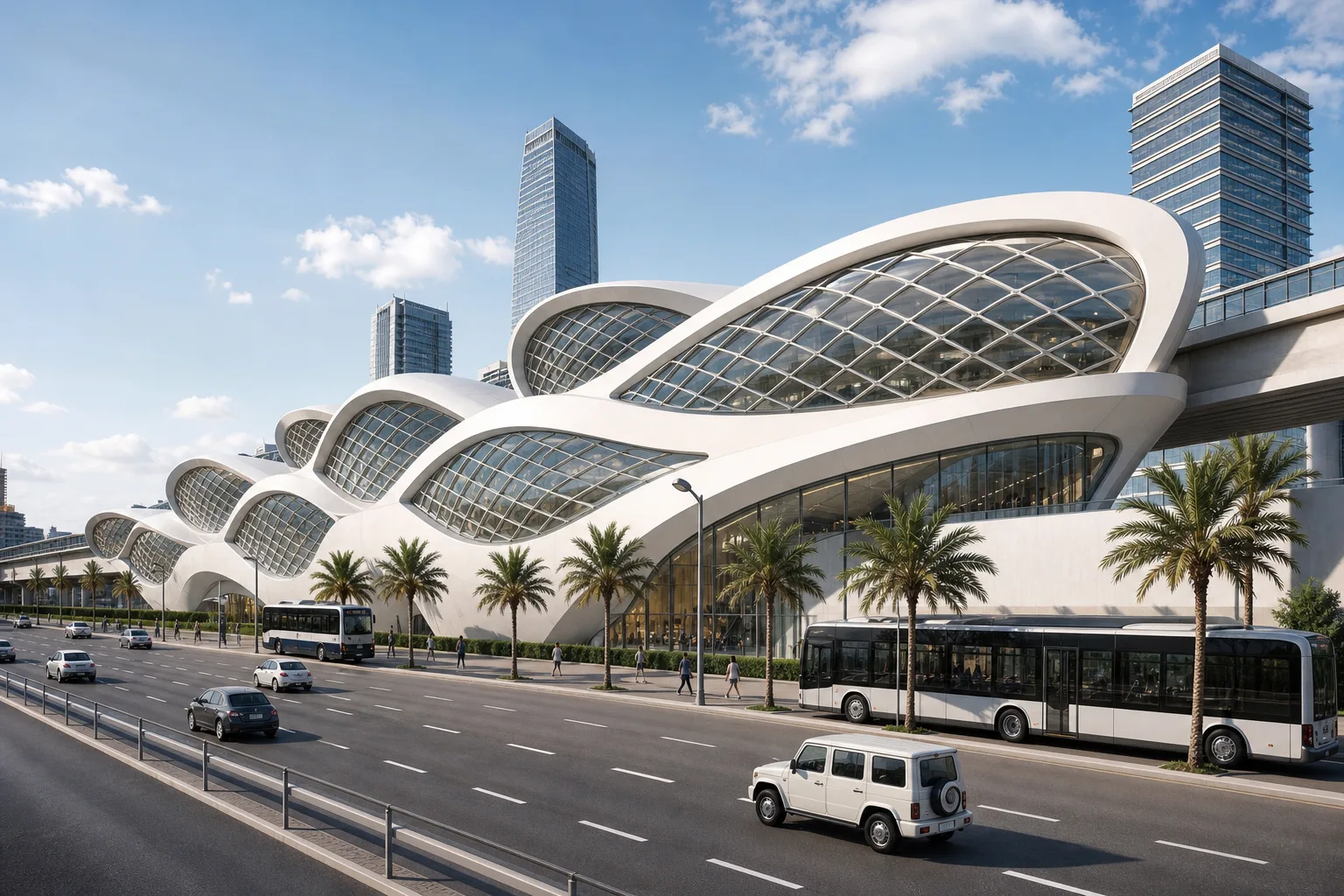
Looped Transit Hall with Fluid Urban Envelope
Architectural Topic
Looped Transit Hall with Fluid Urban Envelope is an architectural gallery study focused on exterior design, using contemporary minimal, exterior, monolithic volumes to explain the image as a practical reference for facade, massing, material, and spatial decisions.
Formally, the building sits in a lineage that runs from late high-tech through parametric neo-futurism, echoing work by practices invested in smooth tectonics and continuous envelopes rather than discrete façades. The elongated, lens-shaped openings articulate a rhythmic datum along the horizon, while their variable heights and spans keep the section in flux. Each loop reads as a structural band that both frames and shades the interior, yet the project resists overt expressionism by holding a strong, almost infrastructural linear axis along the transport corridor. The adjacent office towers provide a vertical counterpoint, but the station’s profile holds its own as a horizontal figure in the skyline.
The massing strategy relies on a clear dialogue between compression and release. At ground level, a largely planar wall punctuated by tall glazing bays supports the sweeping superstructure, giving legible load paths even if the true structural system is more complex than the rendered expression suggests. Above, the white bands thicken at their spring points and thin out as they crest, implying a shell logic that could accommodate integrated beams or edge girders. The elevated viaduct threading across the rear of the composition reinforces this reading of the complex as a hinge between fast, linear movement and slower, volumetric occupation inside the halls.
Fenestration is organized as a continuous diamond-grid curtain wall nested within each loop, with a secondary layer of more conventional vertical glazing at the pedestrian level. This produces a double reading of the envelope: from a distance, an almost scaleless filigree of glass fields; up close, a clear ground datum of shopfront-like bays and entrances. The loops act as deep horizontal brise-soleil, projecting far enough to temper solar gain while preserving visual permeability. Where the shell dips, the glass field narrows, hinting at possible back-of-house or circulation zones; where it swells, the interior likely opens into full-height waiting spaces or ticketing halls with expansive overhead volume. Materially, the project projects a highly controlled palette: a likely glass–fiber-reinforced concrete or similarly smooth cast material for the white shells, paired with high-performance curtain wall systems. The extreme curvature and crisp arrises make traditional in-situ concrete less probable, instead suggesting panelized or precast strategies with carefully concealed joints. Texture is intentionally suppressed to foreground silhouette and shadow; the looped frames catch the sun along their upper ridges while casting deep, soft-edged shadows across the glazing beneath, creating an animated pattern that shifts with the day and reinforces the building’s kinetic association with movement. At the ground plane, a line of evenly spaced palms mediates between highway scale and pedestrian experience, softening the edge without interrupting the building’s strong linear datum. The landscape is minimal but strategic: trunk spacing aligns with the façade bays, extending the structural rhythm into the street section and producing a layered sequence as one approaches from the sidewalk. Vehicles, buses, and elevated trains compose a continuous motion field around the building, so the calm, repetitive shell geometry becomes an anchoring figure against the flux of infrastructure. For designers studying such envelope and massing experiments, a workflow like the concept-to-facade explorations enabled by platforms such as https://www.toscape.ai/—and occasionally unpacked on their YouTube channel—points to how rapidly these kinds of complex curvatures may move from digital speculation to buildable systems. Experientially, one can infer a spatial sequence that oscillates between compressed thresholds and generous halls. Entry likely occurs through relatively modest-height portals at the base, after which the shell geometry lifts away, revealing daylight modulated through the diagrid above. This produces an interior atmosphere both infrastructural and civic: not quite a monumental hall, but more than utilitarian concourse. The building reads as contemporary because its tectonic language is unapologetically synthetic—no nostalgia, no overt iconography—yet it remains contextual in its handling of scale, setting a long, legible datum that clarifies an otherwise chaotic transport corridor and framing the vertical city beyond rather than competing with it outright.
Materials
The material reading is driven by mineral and stone-like tones, using surface depth, shadow, and warm neutral coloration to strengthen the facade's architectural identity.
Style
The style direction reads as contemporary minimal, supported by exterior and monolithic volumes.
Explore Regional & Global StylesBuilding Type
Metro Station
Facade Logic
The facade logic is organized around organic or parametric articulation, where repeated surface movement creates a unified envelope rather than a flat decorative skin.
Explore Related Keywords
1536 × 1024 px
Generation Receipt
Deterministic pipeline: the workflow, style direction and output size below are locked at generation time, so the same inputs reproduce the same visual language.
- Workflow
- Toscape workflow
- Style direction
- Explore Regional & Global Styles
- Output
- 1536 x 1024 px
More from this category


Academy links
Material Swap for Facades and Interiors
Study how material changes alter facade and interior perception.
Re-Render for Concept and Client Review
Learn how to refine existing concepts while protecting studio imagery.
Integrating Toscape into Architectural Production
Connect AI image studies with professional studio workflows.