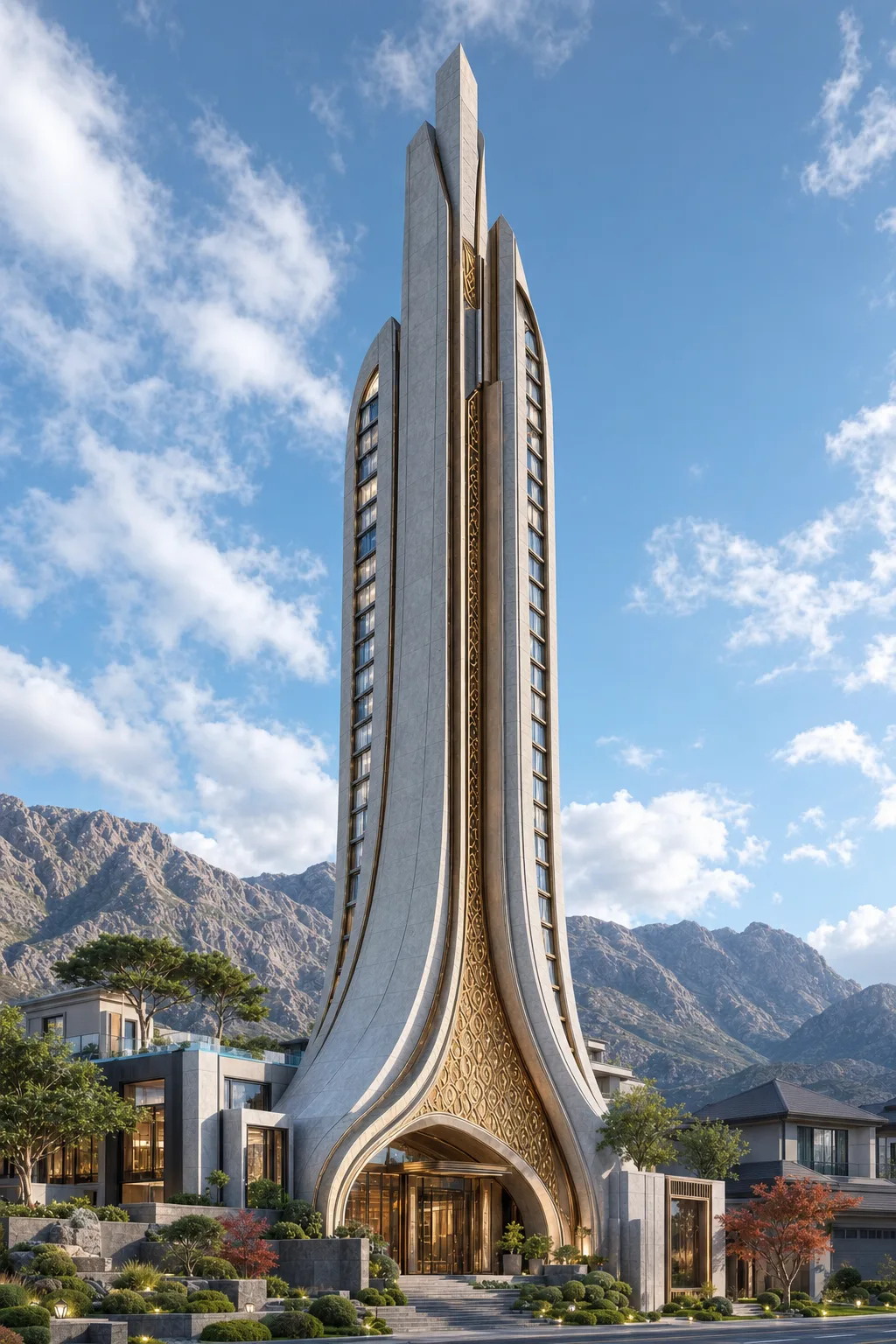
Vertical Minaret Tower with Parametric Ornamental Spine in Mountain Setting
Architectural Topic
Vertical Minaret Tower with Parametric Ornamental Spine in Mountain Setting is an architectural gallery study focused on exterior design, using contemporary neo-islamic, exterior, arched openings to explain the image as a practical reference for facade, massing, material, and spatial decisions.
Stylistically, the work sits between neo-futurism and a contemporary reinterpretation of Islamic or Middle Eastern monumental typologies. The curving concrete or stone-like flanks fuse into a tri-partite spire, evoking minarets or campanili, yet stripped down to smooth planes and precise joints. At the same time, the gold-toned inner surface with intricate geometric filigree introduces a stereotomic–tectonic dialogue: heavy, carved mass framing a lighter, ornamental liner that behaves almost like a climatic screen. This synthesis of smooth aerodynamic profiles and dense ornamental fields aligns more with recent parametric regionalism than with generic global high-rise language.
Conceptually the tower seems to pursue a strong vertical datum anchored by an almost sacral threshold. The base flares outward, lifting the vertical shaft off the ground so that the entrance is literally carved out of the mass, creating a spatial sequence from compressed outer steps to an expansive glazed hall. The building concentrates meaning around this void, letting the envelope bend to form a kind of urban proscenium. Above, three primary blades split and taper, giving the skyline a triptych figure that reinforces the idea of ascent and orientation—something between a landmark beacon and a contemporary minaret, but re-coded for hospitality and dwelling rather than strictly religious use.
Massing strategy is both simple and tightly controlled. A singular central volume rises as the dominant element, while lateral low-rise blocks form a horizontal plinth that reconciles the tower with the scale of neighboring houses. This massing hierarchy lets the tower claim territorial visibility without overwhelming the immediate streetscape; the flanking blocks mediate between mountain ridge, tower shaft, and domestic roofs. The interplay of vertical and horizontal is handled by sweeping curves at the tower’s base that descend into planar retaining walls and terraces, so the stereotomic ground works almost as a landscape extension of the tower’s shell rather than as a separate podium object.
The facade logic revolves around a contrast of smooth, seemingly high-performance cladding panels and deeply recessed, vertically continuous window bands. Fenestration is disciplined: narrow, evenly spaced apertures lined up in tall slots minimize visual clutter and heighten legibility of the primary structural piers. Gold-toned inner spines act as both visual and climatic devices, likely reading as brise-soleil or secondary skins that temper light and glare while projecting a strong symbolic identity. Texture is concentrated where it matters—within the ornamental lattice and around the entrance soffit—leaving the outer shells relatively mute so the building avoids slipping into pastiche.
Materials
The material reading is driven by mineral and stone-like tones, using surface depth, shadow, and warm neutral coloration to strengthen the facade's architectural identity.
Style
The style direction reads as contemporary neo-islamic, supported by exterior and arched openings.
Explore Regional & Global StylesBuilding Type
Hotel
Facade Logic
The facade logic is organized around organic or parametric articulation, where repeated surface movement creates a unified envelope rather than a flat decorative skin.
Explore Related Keywords
1024 × 1536 px
Generation Receipt
Deterministic pipeline: the workflow, style direction and output size below are locked at generation time, so the same inputs reproduce the same visual language.
- Workflow
- Toscape workflow
- Style direction
- Explore Regional & Global Styles
- Output
- 1024 x 1536 px
More from this category


Academy links
Material Swap for Facades and Interiors
Study how material changes alter facade and interior perception.
Re-Render for Concept and Client Review
Learn how to refine existing concepts while protecting studio imagery.
Integrating Toscape into Architectural Production
Connect AI image studies with professional studio workflows.