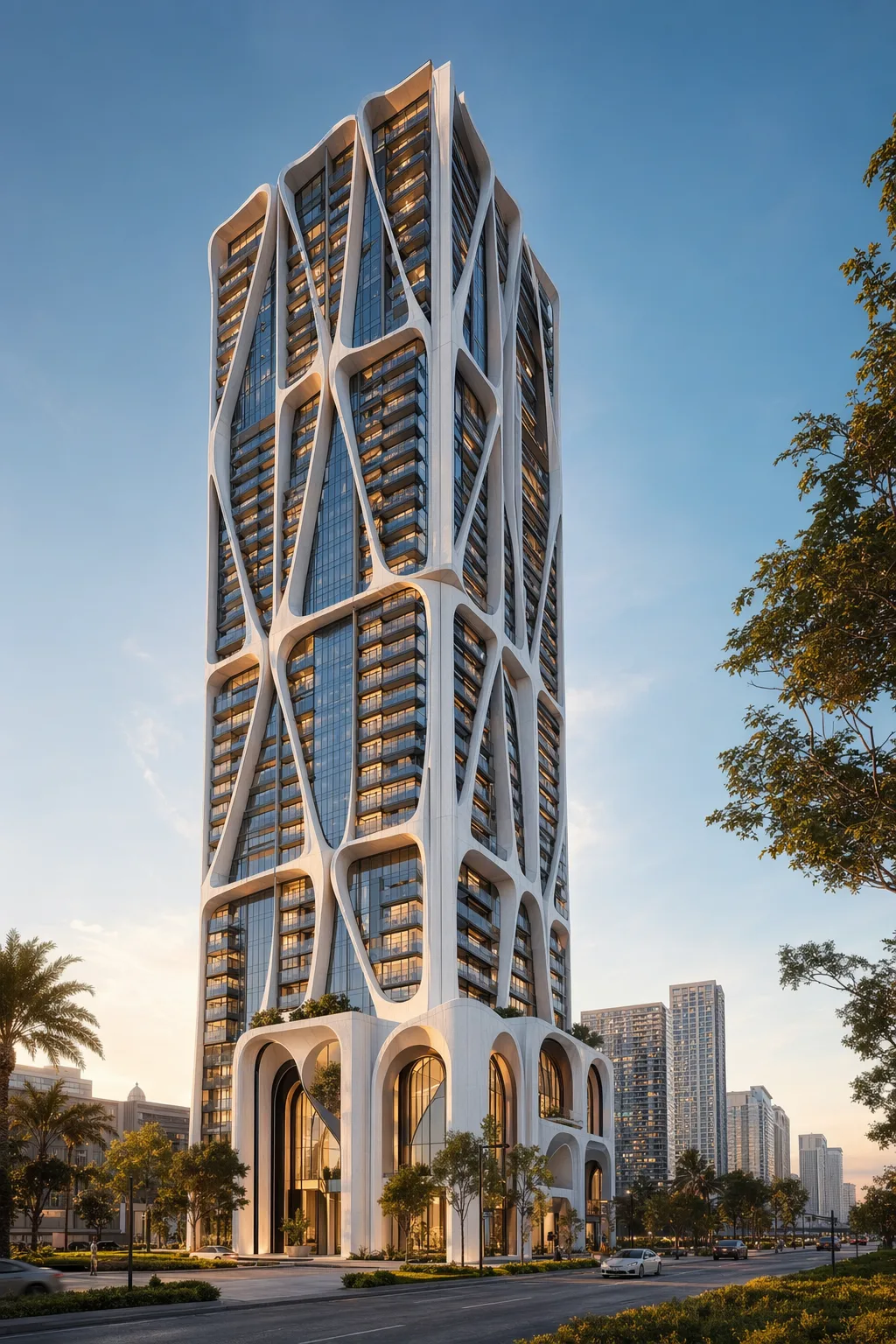
Parametric Exoskeleton Tower with Arched Urban Plinth
Architectural Topic
Parametric Exoskeleton Tower with Arched Urban Plinth is an architectural gallery study focused on exterior design, using contemporary neo-islamic, exterior, arched openings to explain the image as a practical reference for facade, massing, material, and spatial decisions.
Stylistically, the project situates itself in the lineage of expressive structuralism and parametric neo-futurism, borrowing from diagrid language yet softening it into continuous, bone-like ribbons. The white exoskeletal frame is not a neutral curtain; it is the primary tectonic signifier, wrapping the volume with a figure that oscillates between structural diagram, urban ornament, and environmental screen. By contrasting this sculpted outer crust with the darker, planar glazing behind, the design foregrounds a legible hierarchy between structural armature, infill envelope, and occupied depth.
The massing strategy is essentially a prismatic tower subtly chamfered at the corners, but its apparent complexity comes from volumetric articulation of the exoskeleton. Vertical members thicken and splay into broad arches at the base, then taper and cross along the shaft, generating a sequence of diagonals that tighten toward the top. This produces a dynamic load-reading: the eye reads compression at the podium where arches flare and merge, then follows tensioned diagonals upward as if the tower were being laced together. The interplay of these vertical and oblique lines establishes an implicit structural axis without resorting to overt setbacks or crown elements.
Fenestration follows a disciplined, almost infrastructural logic: continuous horizontal balcony bands are stacked in regular increments, while full-height glazing panels recede behind the exoskeletal frame. This recession creates generous reveal depths, allowing the white frame to act as brise-soleil and visual screen, particularly on the sun-exposed faces. Openings at the base are grand, double- and triple-height arches, yet the glass surfaces remain planar, so the perception of curvature comes entirely from the frame’s thickness and radius. Visual permeability is thus modulated more by the frame’s density and depth than by the glass itself, toggling between transparency at the podium and a more veiled, layered reading along the shaft.
Materially, the white exoskeleton is likely a high-performance GFRC or precast concrete cladding system, possibly compositely acting with a concealed structural frame, though the image alone cannot fully confirm its load-bearing role. Its smooth, almost stone-like finish suggests a monolithic reading, while the darker curtain wall behind appears to be conventional glazing with thermally broken frames, tuned for envelope performance. At the base, the arches are thick enough to imply stereotomic mass, yet their crisp edges and thin intrados hint at a cladding strategy rather than solid construction. The resulting material stratigraphy sets up a clear contrast between a cool, continuous outer shell and a warm, reflective inner skin.
Materials
The material reading is driven by mineral and stone-like tones, using surface depth, shadow, and warm neutral coloration to strengthen the facade's architectural identity.
Style
The style direction reads as contemporary neo-islamic, supported by exterior and arched openings.
View the Urban Contemporary style guideBuilding Type
Apartment Tower
Facade Logic
The facade logic is organized around organic or parametric articulation, where repeated surface movement creates a unified envelope rather than a flat decorative skin.
Explore Related Keywords
1024 × 1536 px
Generation Receipt
Deterministic pipeline: the workflow, style direction and output size below are locked at generation time, so the same inputs reproduce the same visual language.
- Workflow
- Toscape workflow
- Style direction
- Urban Contemporary
- Output
- 1024 x 1536 px
More from this category


Academy links
Material Swap for Facades and Interiors
Study how material changes alter facade and interior perception.
Re-Render for Concept and Client Review
Learn how to refine existing concepts while protecting studio imagery.
Integrating Toscape into Architectural Production
Connect AI image studies with professional studio workflows.