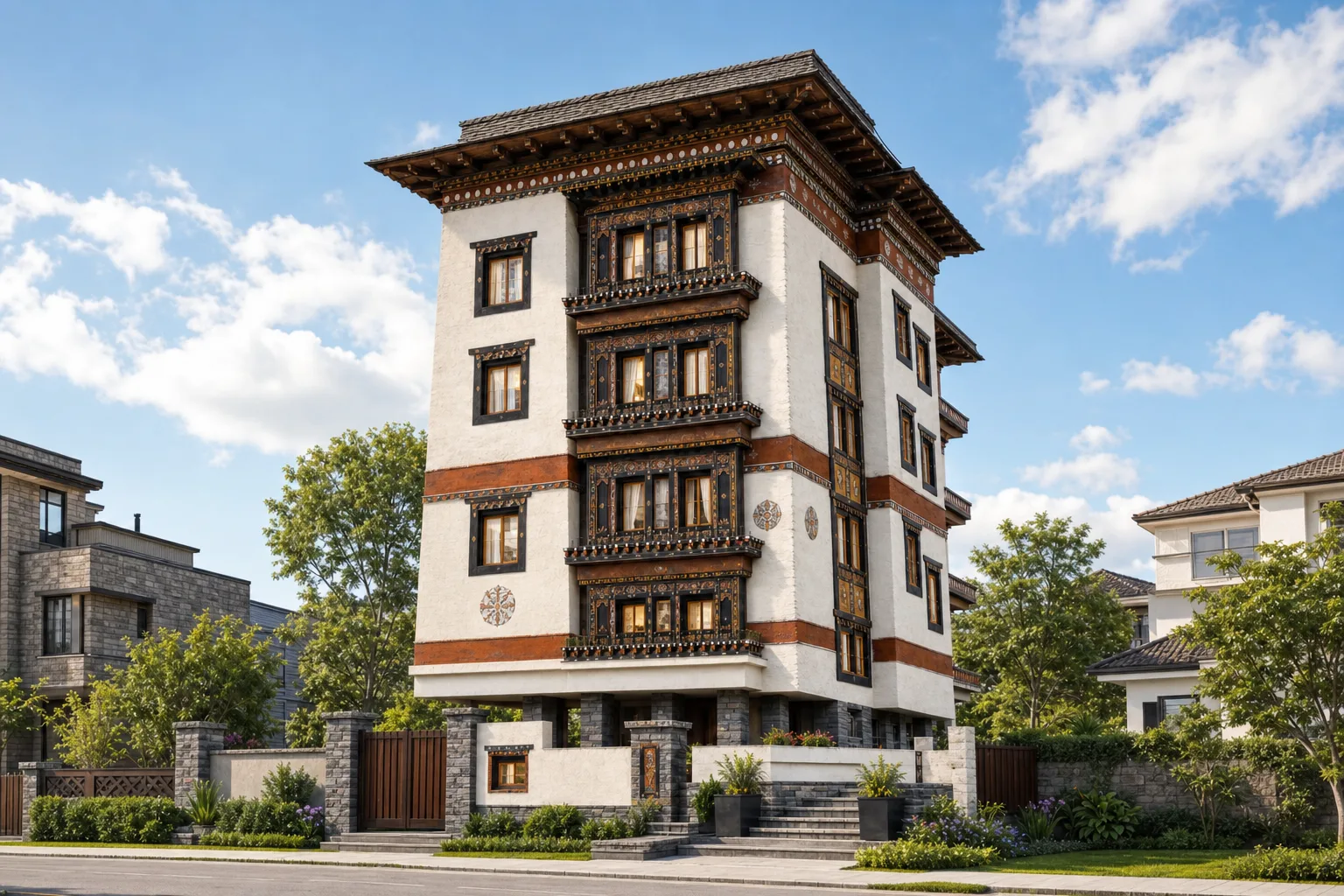
Urban Courtyard Tower with Bhutanese-Inspired Tectonic Expression
Architectural Topic
Urban Courtyard Tower with Bhutanese-Inspired Tectonic Expression is an architectural gallery study focused on exterior design, using mediterranean contemporary, exterior, terraced facade rhythm to explain the image as a practical reference for facade, massing, material, and spatial decisions.
Stylistically the project draws heavily from Bhutanese and wider Himalayan precedents, filtered through the lens of current mid-rise residential development. The richly carved window surrounds, dark timber frames, and polychrome cornice boards point to a lineage of monastic and dzong architecture, but are aligned on a rigorously orthogonal grid rather than the more organic aggregations of traditional hilltop complexes. Ornament is deployed not as appliqué but as a secondary tectonic layer: the carved frames articulate the thickness of the envelope, turning each opening into a small, inhabitable facade element. The result is a hybrid language where cultural specificity is expressed through detail while the underlying massing remains efficient and developer-friendly.
Conceptually there is a strong reading of stacked courtyards turned inside-out to the street. The central bay of tripartite windows projects subtly, reinforced by horizontal bands, creating a vertical axis that organises the facade and suggests a principal internal circulation or living zone aligned with this more generous glazing. Flanking planes, punctured with smaller windows, read as more private rooms, tightening the visual permeability. This arrangement sets up a spatial sequence from a lifted entry terrace at the plinth, through a probable lobby behind the central bay, and then upwards along the vertical datum of larger apertures, almost like a domestic tower whose social spaces are inscribed on the facade.
The massing strategy is straightforward yet carefully tuned: a near-rectangular volume, slightly tapered visually by the extended roof and the heavier base. The voided ground level, expressed through exposed stone piers and recessed infill, lightens the load-reading of the building and creates a threshold zone between street and interior. Above, the envelope thickens around openings; deep mullions, projecting sills, and continuous cornice bands create strong shadow lines that modulate the wall plane. Verticality and horizontality are held in tension: long timber bands pull the eye laterally, while the stacked central bays and tall corner strips assert the building’s upright stance.
Facade logic is tightly disciplined. Window modules repeat with almost obsessive regularity, each framed by dark timber, painted ornament, and small projecting brackets that act as both micro-sunshades and cultural signifiers. The depth of these frames improves envelope performance in a basic but effective way, mitigating solar gain and glare while preserving outward views. The white render, likely a plaster or stucco over masonry or concrete, provides a high-albedo background, so the darker timber and red bands read as inlaid strata in the material section. At the roof, the exaggerated overhang, layered rafters, and shingle-like roofing assert a climatic intelligence, casting the upper facade in deep shade and protecting the walls from rain.
Materials
The material reading is driven by mineral and stone-like tones, using surface depth, shadow, and warm neutral coloration to strengthen the facade's architectural identity.
Style
The style direction reads as mediterranean contemporary, supported by exterior and terraced facade rhythm.
Explore Regional & Global StylesBuilding Type
Apartment Building
Facade Logic
The facade logic is organized around organic or parametric articulation, where repeated surface movement creates a unified envelope rather than a flat decorative skin.
Explore Related Keywords
1536 × 1024 px
Generation Receipt
Deterministic pipeline: the workflow, style direction and output size below are locked at generation time, so the same inputs reproduce the same visual language.
- Workflow
- Toscape workflow
- Style direction
- Explore Regional & Global Styles
- Output
- 1536 x 1024 px
More from this category


Academy links
Material Swap for Facades and Interiors
Study how material changes alter facade and interior perception.
Re-Render for Concept and Client Review
Learn how to refine existing concepts while protecting studio imagery.
Integrating Toscape into Architectural Production
Connect AI image studies with professional studio workflows.