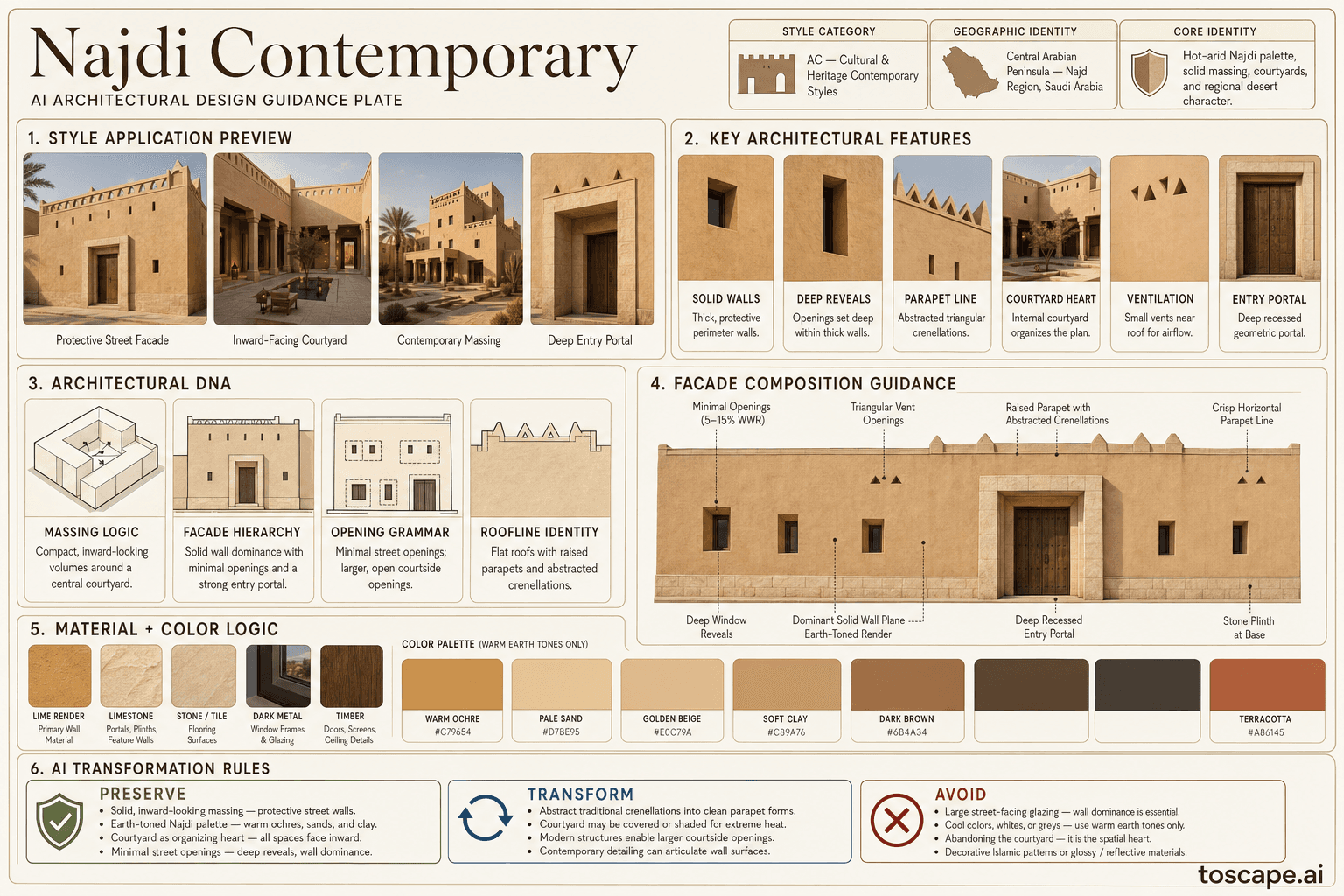
Najdi Contemporary
Central Arabian Peninsula - the Najd region of Saudi Arabia. / Cultural heritage
Hot-arid Najdi palette, thick inward-looking walls, solid massing, and regional desert character.
Definition
Najdi Contemporary is a global architectural style within the cultural heritage. Hot-arid Najdi palette, thick inward-looking walls, solid massing, and regional desert character.
- Family
- Cultural heritage
- Origin
- Central Arabian Peninsula - the Najd region of Saudi Arabia.
- Massing
- Massing is compact and inward-looking. A protective perimeter wall enclosing an internal courtyard.
- Materials
- Walls: lime-based render in warm earth tones.
- Palette
- Primary tones: warm ochre, pale sand, golden beige, soft clay Accent tones: dark brown, charcoal, muted terracotta The palette derives from the Najdi desert landscape.
- Climate response
- Central Arabian Peninsula. The Najd region of Saudi Arabia.
Try it free
Render your own project in this style
Upload one photo of your own project and Re-Render keeps the geometry and camera while carrying the Najdi Contemporary language into materials, proportion, and detail. Three free renders, no account needed.
Open Re-Render - freeOverview
Najdi Contemporary is a global architectural style rooted in Central Arabian Peninsula - the Najd region of Saudi Arabia. Adapted for hot-arid desert climates with extreme diurnal temperature swings, low humidity, dust storms, and strong cultural traditions of privacy and hospitality. Hot-arid Najdi palette, thick inward-looking walls, solid massing, and regional desert character. Grounded, dignified, and authentically regional.
Visual DNA
Massing & Form
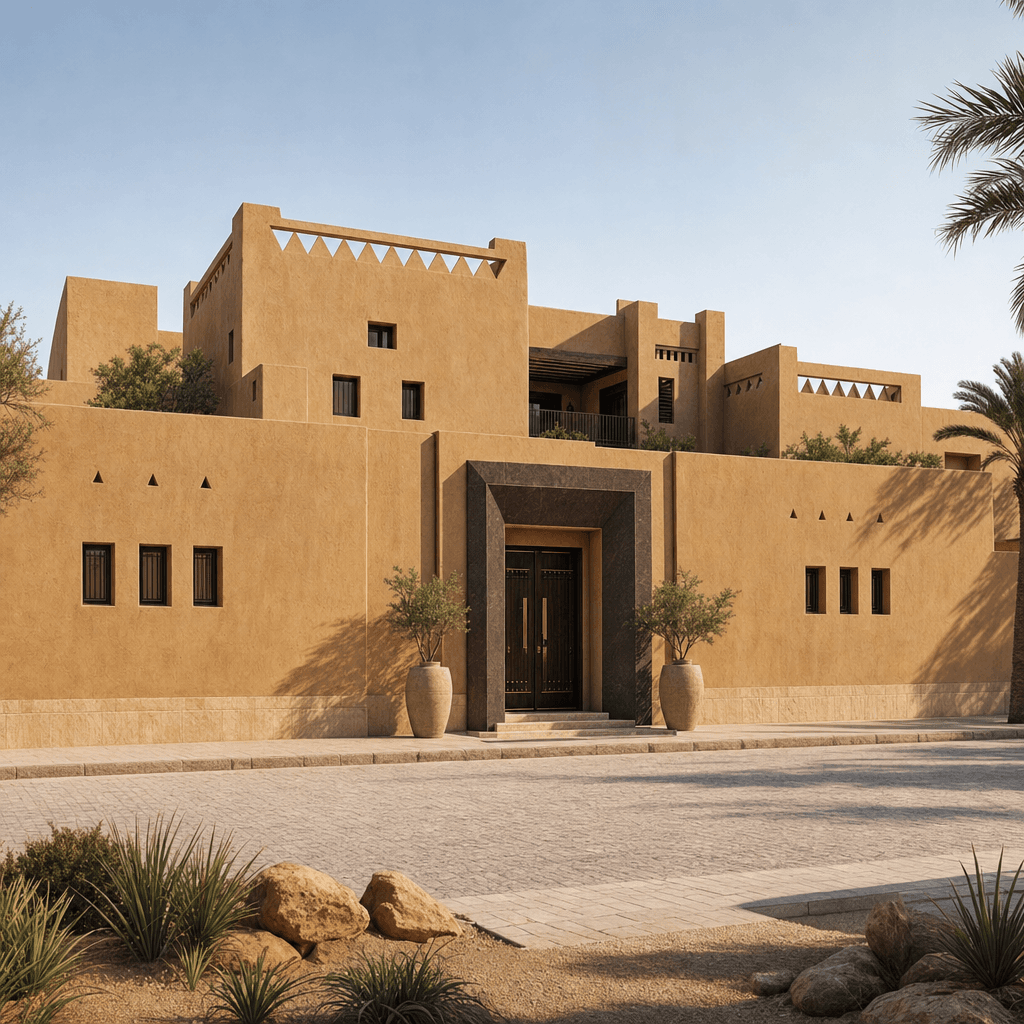
Massing is compact and inward-looking. a protective perimeter wall enclosing an internal courtyard.
Facade Language
The street facade is a dominant solid wall plane in warm earth-toned render. ochre, sand, or warm beige.
Materials & Texture
Walls: lime-based render in warm earth tones.
Color Palette
Primary tones: warm ochre, pale sand, golden beige, soft clay Accent tones: dark brown, charcoal, muted terracotta The palette derives from the Najdi desert landscape. sand, rock, and earth No cool colors, no whites.
Ornament & Detail
Solid, inward-looking massing. street facades are protective walls, not displays.
Climate Response
Central Arabian Peninsula. the Najd region of Saudi Arabia.
Landscape & Ground
Central Arabian Peninsula. the Najd region of Saudi Arabia.
Reference elevation
Najdi Contemporary - characteristic facade composition within the cultural heritage.
Context Snapshot
Grounded, dignified, and authentically regional. Massing is compact and inward-looking - a protective perimeter wall enclosing an internal courtyard. Central Arabian Peninsula - the Najd region of Saudi Arabia.
Contemporary Relevance
Today, Najdi Contemporary remains relevant wherever projects need cultural heritage cues without losing performance or contemporary usability. In Toscape it responds best when prompts emphasize massing is compact and inward-looking - a protective perimeter wall enclosing an internal courtyard. walls: lime-based render in warm earth tones - ochre, sand, warm beige accent stone: local limestone or sandstone for portals, plinths, and feature walls flooring:...
Use this style in Toscape
Explore Najdi Contemporary directly inside Toscape using Facade Re-Style and design workflow prompts tuned for global architectural references.
Open Najdi Contemporary in the galleryFrequently asked questions
What is Najdi Contemporary?
Najdi Contemporary is a global architectural style within the cultural heritage. Hot-arid Najdi palette, thick inward-looking walls, solid massing, and regional desert character.
What materials define Najdi Contemporary?
Walls: lime-based render in warm earth tones.
What is the Najdi Contemporary color palette?
Primary tones: warm ochre, pale sand, golden beige, soft clay Accent tones: dark brown, charcoal, muted terracotta The palette derives from the Najdi desert landscape. Sand, rock, and earth No cool colors, no whites.
What is the origin of Najdi Contemporary?
Grounded, dignified, and authentically regional. Massing is compact and inward-looking - a protective perimeter wall enclosing an internal courtyard. Central Arabian Peninsula - the Najd region of Saudi Arabia.
When should architects use Najdi Contemporary?
Today, Najdi Contemporary remains relevant wherever projects need cultural heritage cues without losing performance or contemporary usability. In Toscape it responds best when prompts emphasize massing is compact and inward-looking - a protective perimeter wall enclosing an internal courtyard.
How do you render Najdi Contemporary in Toscape?
Toscape renders your own photograph, elevation, sketch, or CAD view through the Najdi Contemporary reference. The Facade Re-Style and Design Options workflows keep the building's geometry and camera fixed while the surface language shifts toward Najdi Contemporary.
Other styles in the Cultural heritage family
- Mashrabiya ContemporaryFiltered envelope, layered screening, solid core reading, and contemporary mashrabiya facade logic.
- Andalusian ContemporarySouthern Iberian palette, patio-based organization, terraces, and contemporary Mediterranean spatial character.
- Moroccan ContemporaryWarm Moroccan palette, tactile courtyard-oriented massing, sun-shaped forms, and crafted material depth.
- ADOBE / PUEBLO REVIVAL ARCHITECTURERounded organic earth forms - thick adobe or adobe-like walls (earth plaster over frame or true.
- African Contemporary VernacularRegionally grounded tectonics, compound logic, courtyard organization, veranda edges, and vernacular reinterpretation.
- DRY STONE / STONEMASONRY WITHOUT MORTARStone walls built without mortar - stones selected and placed to interlock by weight and friction.