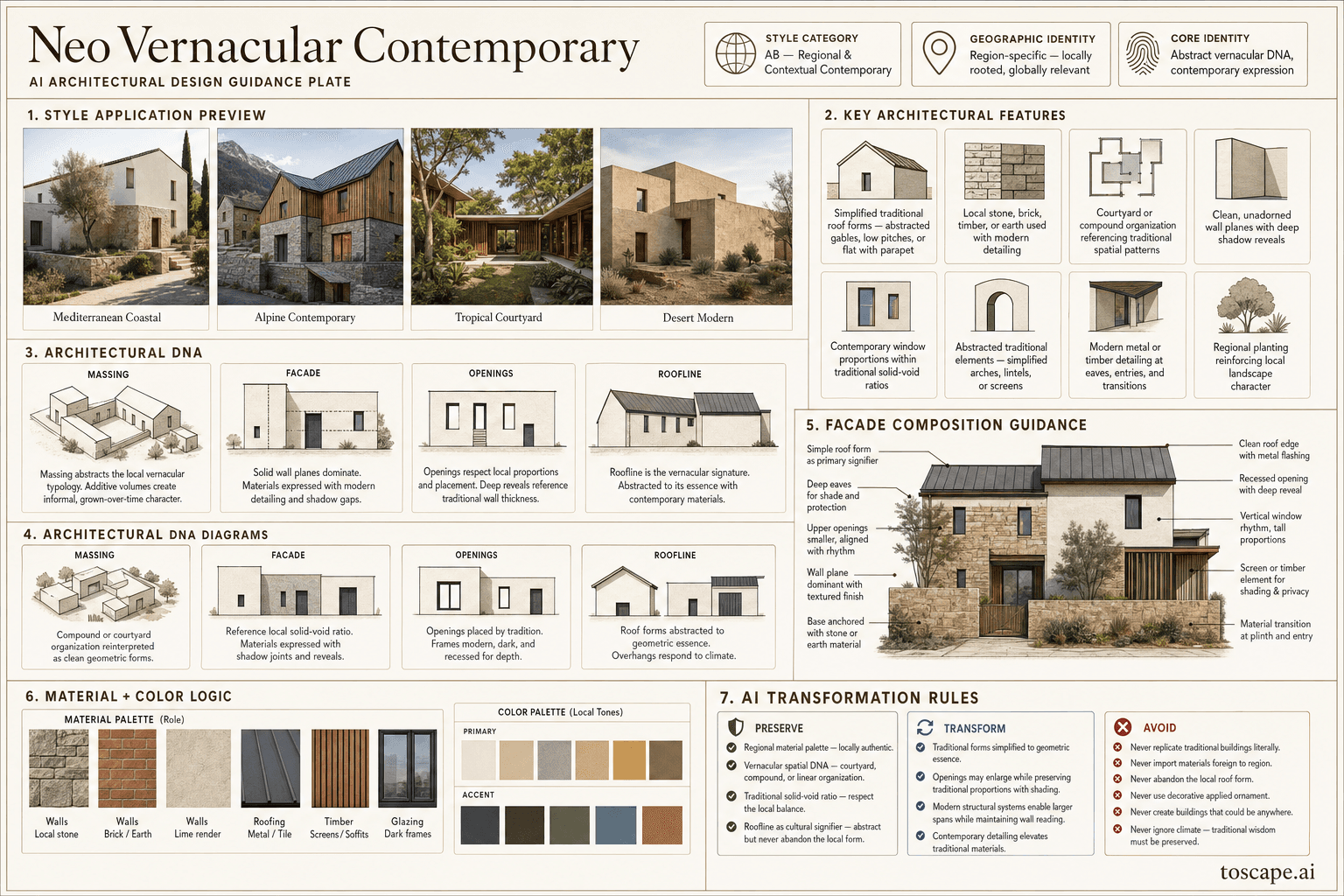
Neo Vernacular Contemporary
Region-specific - each application draws from a particular vernacular tradition (Mediterr... / Regional contemporary
Abstracted vernacular cues, local materials, simplified gables or courtyard walls, and contemporary restraint.
Definition
Neo Vernacular Contemporary is a global architectural style within the regional contemporary. Abstracted vernacular cues, local materials, simplified gables or courtyard walls, and contemporary restraint.
- Family
- Regional contemporary
- Origin
- Region-specific - each application draws from a particular vernacular tradition (Mediterr.
- Massing
- Massing abstracts the local vernacular typology. Traditional compound layouts, courtyard houses, linear farmsteads, or clustered villages are reinterpreted as clean geometric compositions.
- Materials
- Walls: local stone, brick, rammed earth, or lime render.
- Palette
- Colors derive from the local vernacular palette. Never imported Stone tones: local geological colors.
- Climate response
- Region-specific. Each application draws from a particular vernacular tradition (Mediterranean, Alpine, Tropical, Desert, Nordic, etc.
Try it free
Render your own project in this style
Upload one photo of your own project and Re-Render keeps the geometry and camera while carrying the Neo Vernacular Contemporary language into materials, proportion, and detail. Three free renders, no account needed.
Open Re-Render - freeOverview
Neo Vernacular Contemporary is a global architectural style rooted in Region-specific - each application draws from a particular vernacular tradition (Mediterranean, Alpine, Tropical, Desert, Nordic, etc.) reinterpreted through contemporary design. The approach is global but always locally rooted. Abstracted vernacular cues, local materials, simplified gables or courtyard walls, and contemporary restraint. Familiar yet fresh - the architecture evokes a sense of belonging and cultural continuity without nostalgia or pastiche.
Visual DNA
Massing & Form
Massing abstracts the local vernacular typology. Traditional compound layouts, courtyard houses, linear farmsteads, or clustered villages are reinterpreted as clean geometric compositions.
Facade Language
Facades reference local wall-to-opening ratios but execute them with modern materials and detailing. Solid wall planes dominate, with openings punched as clean apertures.
Materials & Texture
Walls: local stone, brick, rammed earth, or lime render. detailed with contemporary precision Roofing: standing-seam metal, clay/concrete tile, or slate in local colors Timber: locally appropriate species for screens, soffits, and details...
Color Palette
Colors derive from the local vernacular palette. never imported Stone tones: local geological colors.
Ornament & Detail
Regional material palette. always use locally authentic materials.
Climate Response
Region-specific. each application draws from a particular vernacular tradition (Mediterranean, Alpine, Tropical, Desert, Nordic, etc.
Landscape & Ground
Region-specific. each application draws from a particular vernacular tradition (Mediterranean, Alpine, Tropical, Desert, Nordic, etc.
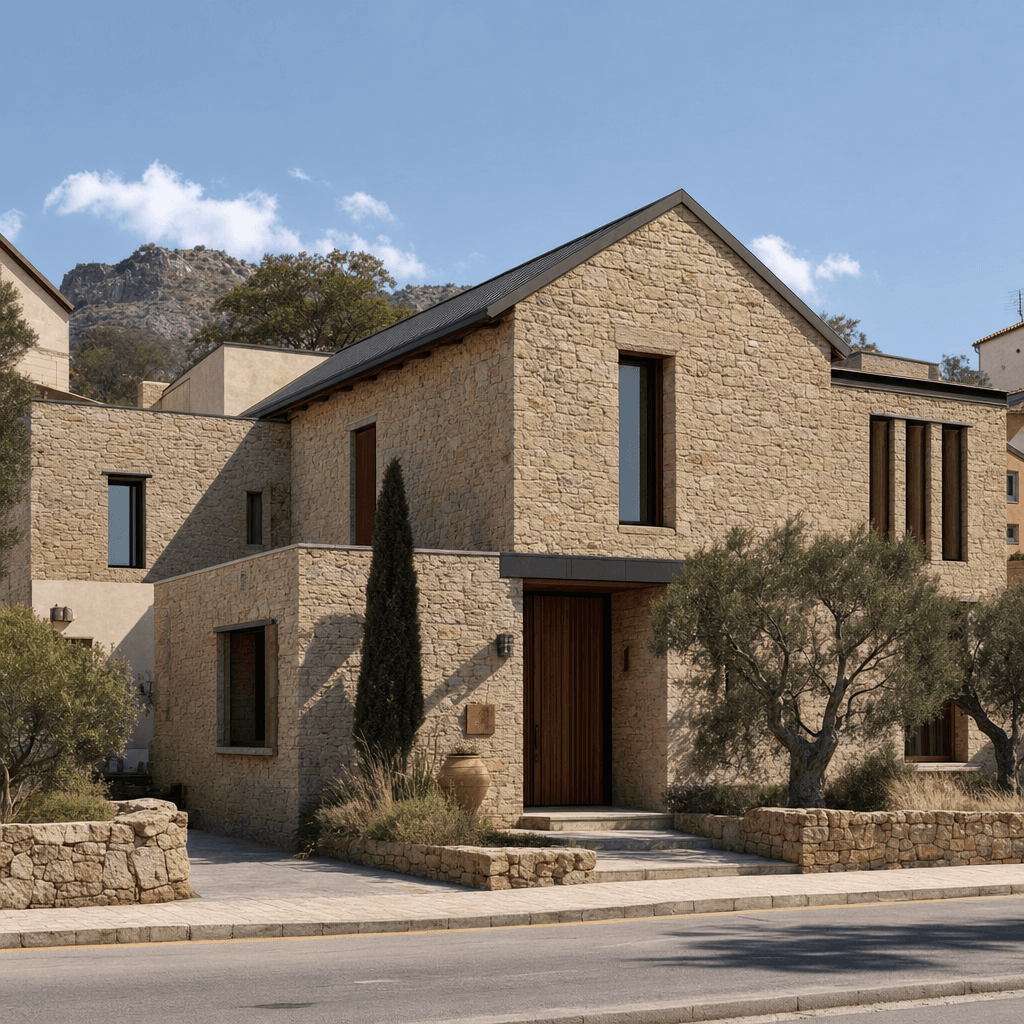
Reference elevation
Neo Vernacular Contemporary - characteristic facade composition within the regional contemporary.
Context Snapshot
Familiar yet fresh - the architecture evokes a sense of belonging and cultural continuity without nostalgia or pastiche. Massing abstracts the local vernacular typology. Region-specific - each application draws from a particular vernacular tradition (Mediterranean, Alpine, Tropical, Desert, Nordic, etc.) reinterpreted through contemporary design.
Contemporary Relevance
Today, Neo Vernacular Contemporary remains relevant wherever projects need regional contemporary cues without losing performance or contemporary usability. In Toscape it responds best when prompts emphasize massing abstracts the local vernacular typology. walls: local stone, brick, rammed earth, or lime render - detailed with contemporary precision roofing: standing-seam metal, clay/concrete tile, or slate in local colors timber: locally appropriate...
Use this style in Toscape
Explore Neo Vernacular Contemporary directly inside Toscape using Facade Re-Style and design workflow prompts tuned for global architectural references.
Open Neo Vernacular Contemporary in the galleryFrequently asked questions
What is Neo Vernacular Contemporary?
Neo Vernacular Contemporary is a global architectural style within the regional contemporary. Abstracted vernacular cues, local materials, simplified gables or courtyard walls, and contemporary restraint.
What materials define Neo Vernacular Contemporary?
Walls: local stone, brick, rammed earth, or lime render. Detailed with contemporary precision Roofing: standing-seam metal, clay/concrete tile, or slate in local colors Timber: locally appropriate species for screens, soffits, and details.
What is the Neo Vernacular Contemporary color palette?
Colors derive from the local vernacular palette. Never imported Stone tones: local geological colors.
What is the origin of Neo Vernacular Contemporary?
Familiar yet fresh - the architecture evokes a sense of belonging and cultural continuity without nostalgia or pastiche. Massing abstracts the local vernacular typology. Region-specific - each application draws from a particular vernacular tradition (Mediterranean, Alpine, Tropical, Desert, Nordic, etc. ) reinterpreted through contemporary design.
When should architects use Neo Vernacular Contemporary?
Today, Neo Vernacular Contemporary remains relevant wherever projects need regional contemporary cues without losing performance or contemporary usability. In Toscape it responds best when prompts emphasize massing abstracts the local vernacular typology. Walls: local stone, brick, rammed earth, or lime render - detailed with contemporary precision roofing: standing-seam metal, clay/concrete tile, or slate in local colors timber: locally appropriate.
How do you render Neo Vernacular Contemporary in Toscape?
Toscape renders your own photograph, elevation, sketch, or CAD view through the Neo Vernacular Contemporary reference. The Facade Re-Style and Design Options workflows keep the building's geometry and camera fixed while the surface language shifts toward Neo Vernacular Contemporary.
Other styles in the Regional contemporary family
- Urban ContemporaryCompact stacked urban volumes, durable metropolitan materials, and efficient city-facing facade logic.
- Gulf ContemporaryPremium hot-climate palette, inward-facing luxury, strong privacy boundaries, and composed modern massing.
- Critical RegionalismPlace-specific materials, tectonic clarity, topography-driven form, and strong climate response.
- AUSTRALIAN CONTEMPORARY VERNACULARCorrugated galvanized iron as roof and wall - lightweight linear pavilion forms - buildings that float.
- Desert ContemporaryLow sheltering heat-defensive volumes, matte mineral finishes, deep shade, and hot-arid performance.
- INDIAN CONTEMPORARY ARCHITECTURECourtyard-centered spatial organization - climate-responsive shading and natural ventilation - exposed brick and local stone.