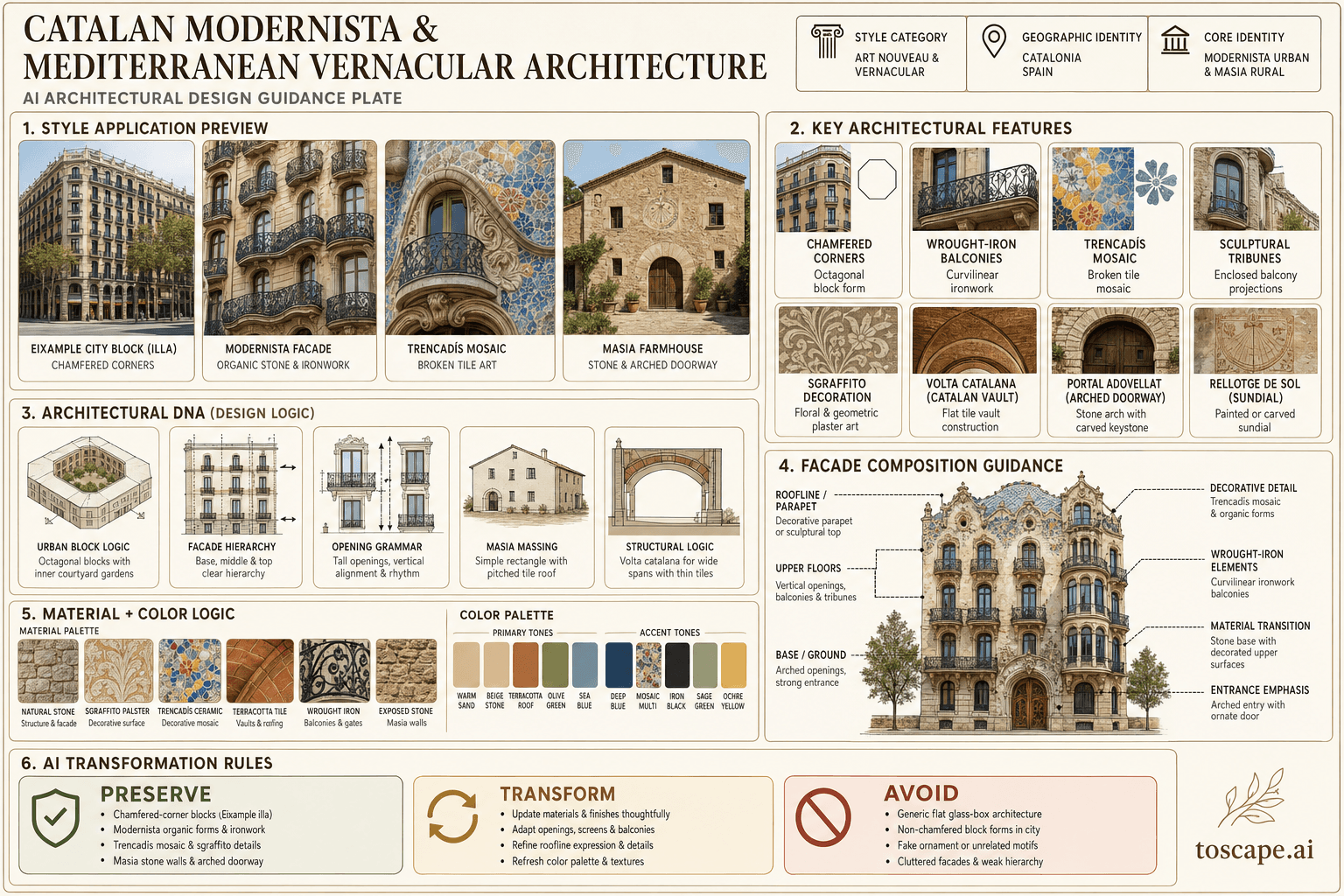
Catalan Modernista & Mediterranean Vernacular
Spain · Two distinct Catalan architectures
The Gothic-Art Nouveau urban fabric of Barcelona and the stone masia farmhouses of the Catalan countryside
Definition
Catalan Modernista & Mediterranean Vernacular is a regional architectural identity from Spain. The Gothic-Art Nouveau urban fabric of Barcelona and the stone masia farmhouses of the Catalan countryside.
- Country
- Spain
- Region
- Two distinct Catalan architectures.
- Massing
- Barcelona Eixample: distinctive chamfered-corner city blocks (illa) with inner courtyard gardens — Modernista (Catalan Art Nouveau) facades — organic stone carving, wrought-iron balconies, trencadís mosaic.
- Palette
- Stone gray, weathered timber brown, mineral white, muted charcoal, and restrained landscape greens define the palette.
- Climate response
- Two distinct Catalan architectures — the Eixample district of Barcelona (19th-century urban expansion with Modernista architecture) and the masia (stone farmhouse) of the Catalan countryside.
Try it free
Render your own project in this style
Upload one photo of your own project and Re-Render keeps the geometry and camera while carrying the Catalan Modernista & Mediterranean Vernacular language into materials, proportion, and detail. Three free renders, no account needed.
Open Re-Render - freeOverview
Catalan Modernista & Mediterranean Vernacular is a regional architectural identity in Spain. Two distinct Catalan architectures — the Eixample district of Barcelona (19th-century urban expansion with Modernista architecture) and the masia (stone farmhouse) of the Catalan countryside. Barcelona Eixample: distinctive chamfered-corner city blocks (illa) with inner courtyard gardens — Modernista (Catalan Art Nouveau) facades — organic stone carving, wrought-iron balconies, trencadís mosaic, sgraffito plaster dec...
Visual DNA
Massing & Form
Barcelona Eixample: distinctive chamfered-corner city blocks (illa) with inner courtyard gardens — Modernista (Catalan Art Nouveau) facades — organic stone carving, wrought-iron balconies, trencadís mosaic, sgraffito plaster decoration — Catalan vault (volta catalana) — flat ceramic tile vaulting technique. Masia: two...
Facade Language
Barcelona Eixample: distinctive chamfered-corner city blocks (illa) with inner courtyard gardens — Modernista (Catalan Art Nouveau) facades — organic stone carving, wrought-iron balconies, trencadís mosaic, sgraffito plaster decoration — Catalan vault (volta catalana) — flat ceramic tile vaulting technique. Masia: two...
Materials & Texture
Barcelona Eixample: distinctive chamfered-corner city blocks (illa) with inner courtyard gardens — Modernista (Catalan Art Nouveau) facades — organic stone carving, wrought-iron balconies, trencadís mosaic, sgraffito plaster decoration — Catalan vault (volta catalana) — flat ceramic tile vaulting technique. Masia: two...
Color Palette
Stone gray, weathered timber brown, mineral white, muted charcoal, and restrained landscape greens define the palette. The building should feel rooted in terrain and craft rather than coated in synthetic contrast.
Ornament & Detail
Barcelona Eixample: distinctive chamfered-corner city blocks (illa) with inner courtyard gardens — Modernista (Catalan Art Nouveau) facades — organic stone carving, wrought-iron balconies, trencadís mosaic, sgraffito plaster decoration — Catalan vault (volta catalana) — flat ceramic tile vaulting technique. Masia: two...
Climate Response
Two distinct Catalan architectures — the Eixample district of Barcelona (19th-century urban expansion with Modernista architecture) and the masia (stone farmhouse) of the Catalan countryside
Landscape & Ground
Two distinct Catalan architectures — the Eixample district of Barcelona (19th-century urban expansion with Modernista architecture) and the masia (stone farmhouse) of the Catalan countryside
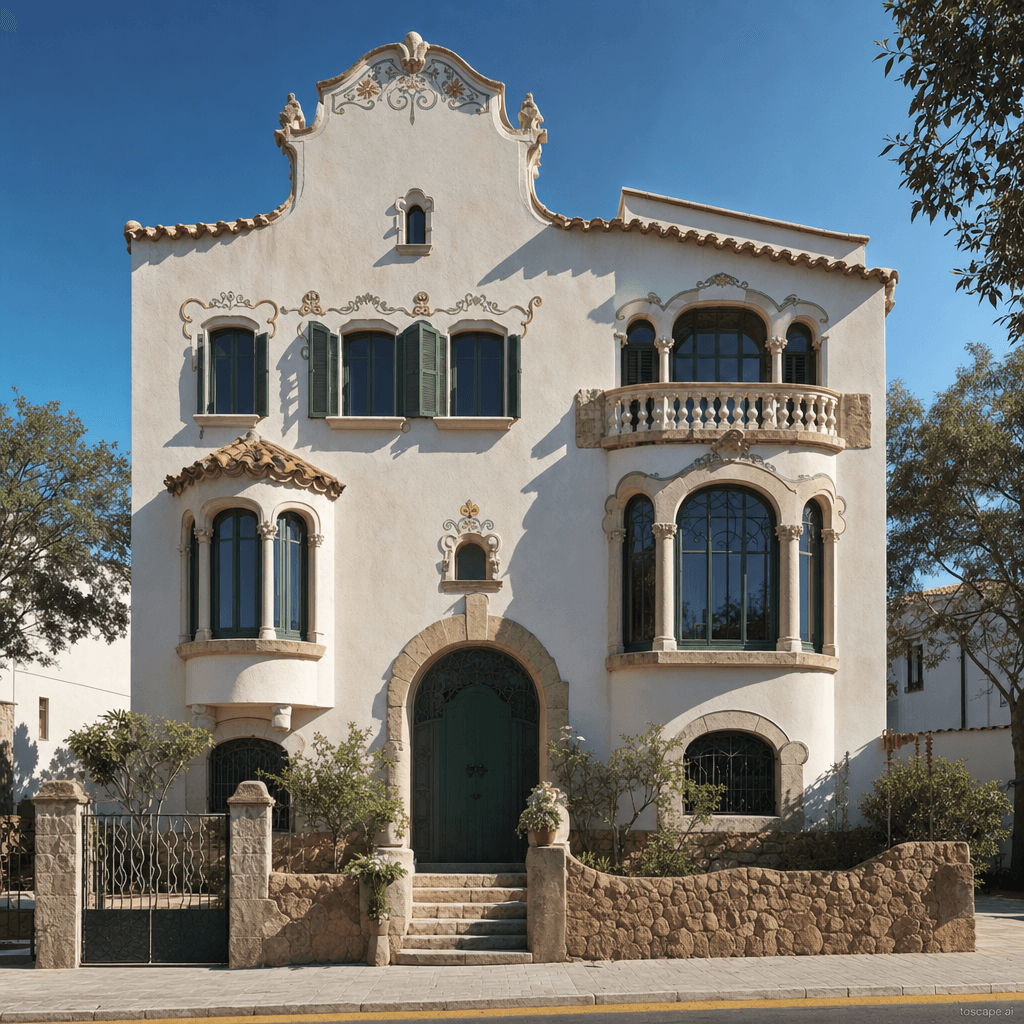
Reference elevation
Catalan Modernista & Mediterranean Vernacular — characteristic facade composition, Two distinct Catalan architectures.
Context Snapshot
Two distinct Catalan architectures — the Eixample district of Barcelona (19th-century urban expansion with Modernista architecture) and the masia (stone farmhouse) of the Catalan countryside
Contemporary Relevance
Catalan Modernista & Mediterranean Vernacular is useful today for residential, hospitality, civic, and place-branding work that needs Spain-specific character grounded in local massing, material tone, climate response, and settlement logic rather than generic international styling.
Use this style in Toscape
Explore Catalan Modernista & Mediterranean Vernacular directly inside Toscape using the Facade Re-Style and Design Options workflows.
Open Catalan Modernista & Mediterranean Vernacular in the galleryFrequently asked questions
What is Catalan Modernista & Mediterranean Vernacular?
Catalan Modernista & Mediterranean Vernacular is a regional architectural identity from Spain. The Gothic-Art Nouveau urban fabric of Barcelona and the stone masia farmhouses of the Catalan countryside.
What materials define Catalan Modernista & Mediterranean Vernacular?
Barcelona Eixample: distinctive chamfered-corner city blocks (illa) with inner courtyard gardens — Modernista (Catalan Art Nouveau) facades — organic stone carving, wrought-iron balconies, trencadís mosaic, sgraffito plaster decoration — Catalan vault (volta catalana) — flat ceramic tile vaulting technique. Masia: two.
What is the Catalan Modernista & Mediterranean Vernacular color palette?
Stone gray, weathered timber brown, mineral white, muted charcoal, and restrained landscape greens define the palette. The building should feel rooted in terrain and craft rather than coated in synthetic contrast.
Where does Catalan Modernista & Mediterranean Vernacular come from?
Two distinct Catalan architectures — the Eixample district of Barcelona (19th-century urban expansion with Modernista architecture) and the masia (stone farmhouse) of the Catalan countryside.
When should architects use Catalan Modernista & Mediterranean Vernacular?
Catalan Modernista & Mediterranean Vernacular is useful today for residential, hospitality, civic, and place-branding work that needs Spain-specific character grounded in local massing, material tone, climate response, and settlement logic rather than generic international styling.
How do you render Catalan Modernista & Mediterranean Vernacular in Toscape?
In Toscape, pick the Catalan Modernista & Mediterranean Vernacular reference from the style library and run it over your own image - a site photo, elevation, sketch, or CAD view. The Facade Re-Style and Design Options workflows hold the geometry and camera of the project and move materials, proportion, and detailing toward Catalan Modernista & Mediterranean Vernacular.
Other regional identities from Spain
- Basque Country Baserri & Urban BayonneThe half-timbered farmhouses (baserri) and Belle Époque coastal architecture of Euskal Herria.
- Canary Islands VolcanicBasalt Stone, Wooden Balconies & Patio-Centered Color Architecture.
- Castilian Meseta Stone & MudéjarThe austere stone and brick architecture of the Spanish central plateau — Mudéjar towers and Segovian.
- Galician Hórreo & Stone VillageThe Atlantic Celtic-influenced stone architecture of northwestern Spain — hórreo granaries and pazos manors.
- Valencia MediterraneanHuerta Farmhouses, Ceramic-Clad Townhouses & Gothic-Mudéjar Merchant Palaces.
- Andalusian White Village & CourtyardThe Moorish-influenced pueblos blancos and patio houses of southern Spain — Islamic legacy in European vernacular.