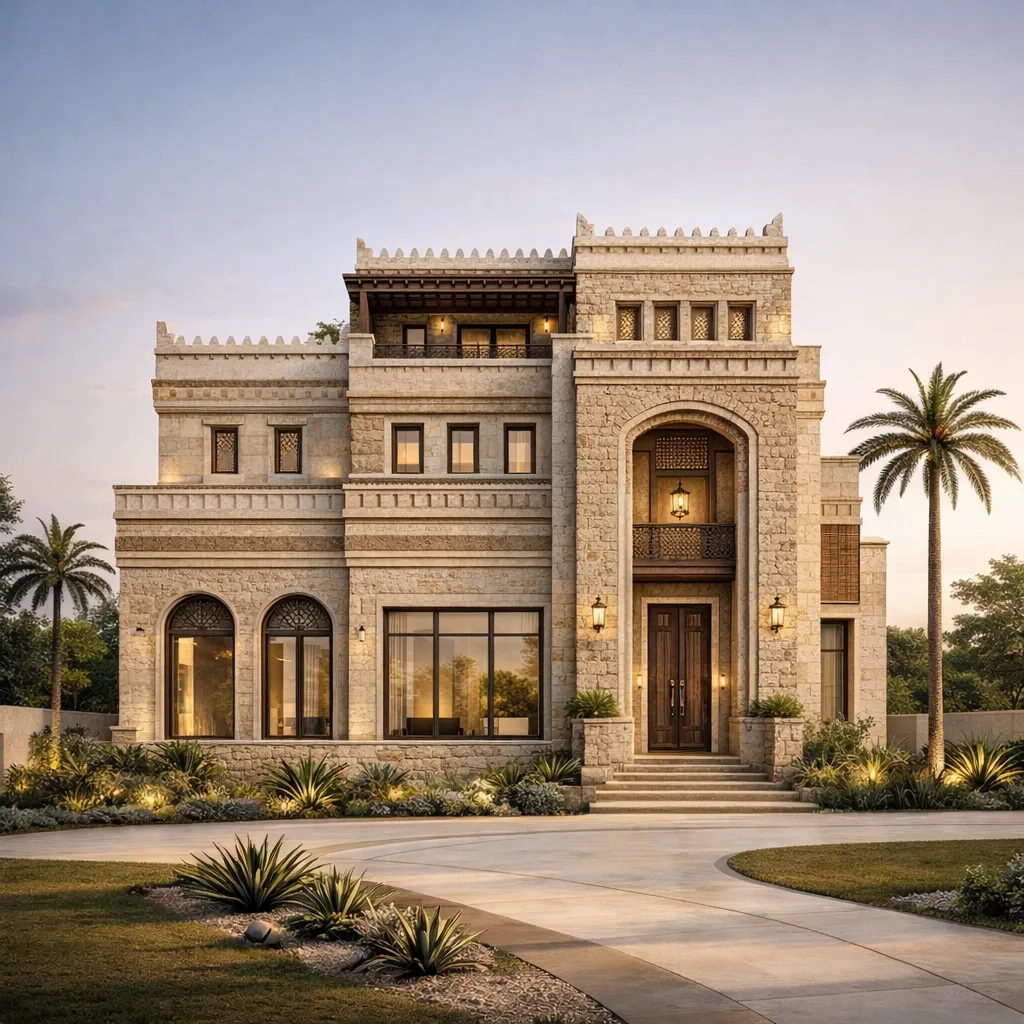
Stone-Cut Courtyard Villa with Neo-Vernacular Arabesque Facade
Architectural Topic
Stone-Cut Courtyard Villa with Neo-Vernacular Arabesque Facade is an architectural gallery study focused on exterior design, using contemporary neo-islamic, exterior, arched openings to explain the image as a practical reference for facade, massing, material, and spatial decisions.
Formally the building operates in a neo-vernacular register, synthesizing regional Middle Eastern influences with contemporary residential expectations. The crenellated parapets, deep stone reveals, and pointed-arch window profiles recall fortified desert and coastal architectures, yet the planarity of the main elevation and the almost curtain-wall-like ground-floor glazing on the left read as unmistakably current. There is a calibrated tension here between stereotomic mass and lighter tectonic insertions, a negotiation that aligns the project with the broader lineage of critical regionalism rather than pure pastiche.
Massing is organized as a stepped tripartite composition: a dominant central tower-like volume flanked by slightly lower wings, producing a legible hierarchy in both height and depth. The central bay is thickened into an almost urban-scale niche containing the entry door and an upper loggia, establishing a strong vertical datum that anchors the facade. Horizontal belt courses, string lines, and subtle cornice bands work against this vertical pull, creating a striated reading of the envelope that breaks down the apparent scale. The result is a measured interlock of vertical aspiration and horizontal grounding, reinforcing a sense of permanence without becoming overbearing.
The facade’s envelope logic relies on a contrast between robust stone cladding and moments of high visual permeability. Narrow, deeply recessed upper windows and mashrabiya-like lattice panels temper solar gain and control privacy, whereas the large, nearly frameless panes at ground level maximize transparency toward the landscape. Arched openings are carved with significant depth, allowing the reveal surfaces themselves to become light-modulating devices rather than mere decorative trims. Lantern-style wall sconces and a pendant within the entry void pick up and dramatize this depth at dusk, reinforcing the perception of the envelope as a thick, inhabitable layer instead of a thin surface.
Materially, the house appears to be wrapped in a warm, roughly dressed stone or high-fidelity stone veneer, its coursing disciplined but not perfectly smooth, inviting a tactile reading of the wall. Trim bands, parapets, and arch frames seem to use a slightly finer or more regular stone, setting up a stratigraphy of base, middle, and crown. Timber or metal latticework at the balcony and smaller upper windows introduces a secondary, more delicate tectonic register against the bulk of the masonry, recalling historical mashrabiya systems while likely relying on contemporary fabrication and fixings. One could imagine concept design or facade iteration workflows similar to those emerging from tools like https://www.toscape.ai/ being used here to quickly test variations in stone banding, arch proportion, and screen density before committing to this particular balance.
Materials
The material reading is driven by mineral and stone-like tones, using surface depth, shadow, and warm neutral coloration to strengthen the facade's architectural identity.
Style
The style direction reads as contemporary neo-islamic, supported by exterior and arched openings.
View the East Coast Traditional style guideBuilding Type
Luxury Villa
Facade Logic
The facade logic uses arches, screens, and layered openings to balance cultural reference, shading depth, and contemporary envelope rhythm.
Explore Related Keywords
1024 × 1024 px
Generation Receipt
Deterministic pipeline: the workflow, style direction and output size below are locked at generation time, so the same inputs reproduce the same visual language.
- Workflow
- Toscape workflow
- Style direction
- East Coast Traditional
- Output
- 1024 x 1024 px
More from this category


Academy links
Material Swap for Facades and Interiors
Study how material changes alter facade and interior perception.
Re-Render for Concept and Client Review
Learn how to refine existing concepts while protecting studio imagery.
Integrating Toscape into Architectural Production
Connect AI image studies with professional studio workflows.