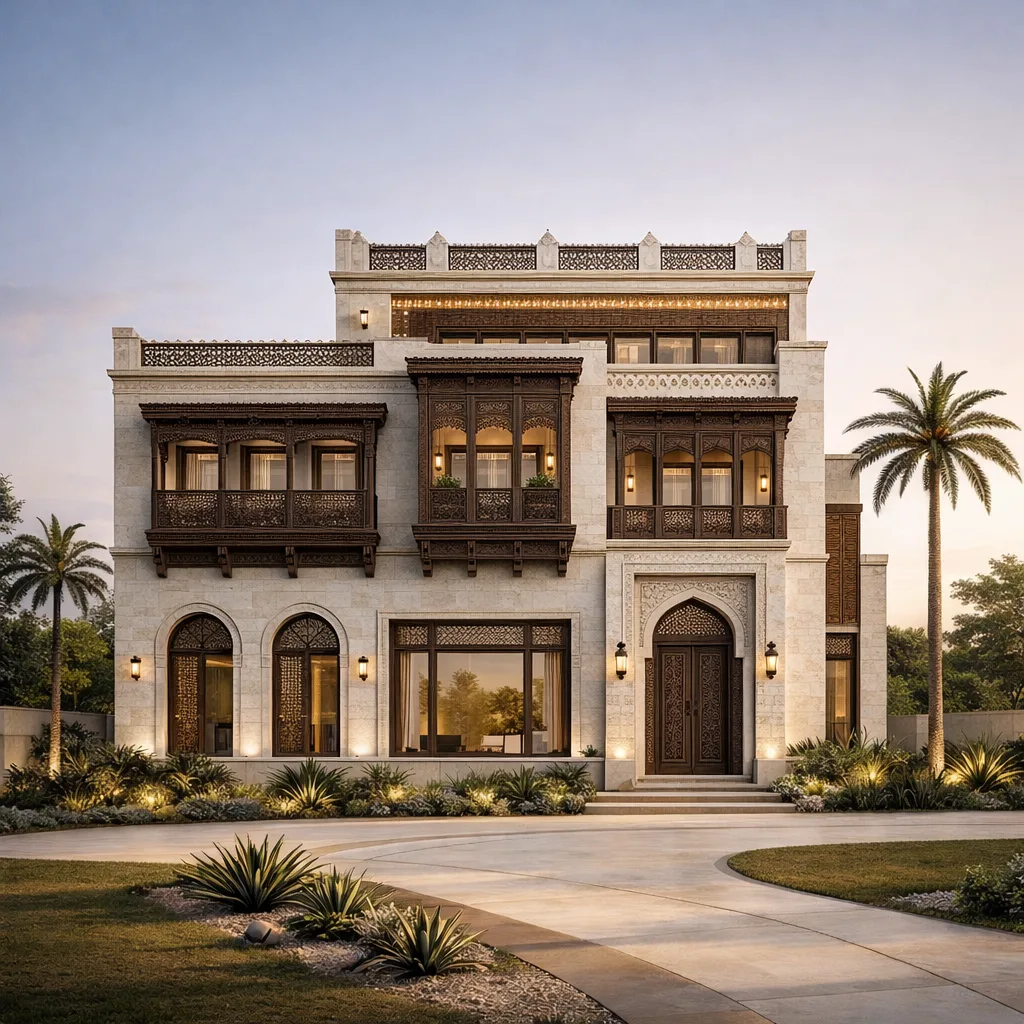
Contemporary Mashrabiya Villa with Layered Islamic Tectonics
Architectural Topic
Contemporary Mashrabiya Villa with Layered Islamic Tectonics is an architectural gallery study focused on exterior design, using contemporary neo-islamic, exterior, arched openings to explain the image as a practical reference for facade, massing, material, and spatial decisions.
Stylistically, the house draws from Islamic and Gulf vernacular lineages—particularly Hijazi and Maghrebi mashrabiya traditions—yet it is recomposed through a contemporary, almost diagrammatic clarity. The stereotomic base in pale stone reads as a quietly rational grid, while the darker timber (or timber-analog) screenwork behaves as a lightweight, tectonic layer set in front of that mass. This two-layer strategy allows the design to negotiate between historical ornamental density and a current preference for planar legibility and precise proportioning.
The massing strategy is essentially a stacked courtyard block, articulated as a tripartite frontal composition with a strong vertical datum at the entrance bay. Projecting oriel elements generate a staggered relief, breaking the facade into a rhythm of solids and suspended volumes without losing the rectangular envelope. A subtle stepping of the parapets on the uppermost level introduces a skyline profile that evokes crenellation, though in a restrained way that keeps the overall figure compact rather than picturesque. Vertical-vertical load cues are reinforced by the heavy piers and framed corner volumes, while the screens and balconies read as non-structural, hovering layers.
Fenestration is handled as a calibrated gradient of visual permeability and solar control. At ground level, large glazed openings with patterned grilles and deep jambs open living spaces toward the garden while maintaining a degree of privacy through texture and partial screening. The upper story intensifies the shading logic: deeply carved mashrabiya bays, likely timber or a high-quality composite, create a porous envelope that filters light, encourages cross-ventilation, and mutates the silhouette as shadows thicken across the day. The facade thus shifts from transparent display below to veiled, lantern-like presence above, echoing climatic priorities in hot, bright regions. Materially, the project appears to rely on a light limestone or travertine cladding for the stereotomic shell, paired with dark stained wood or wood-look aluminum for the screens and balcony structures; the confidence in that reading is high given the grain, tonal separation, and depth of carving. The threshold arch and door surround intensify the tectonic depth through carved stone or high-relief precast, establishing a precise ornamental datum at eye level. At dusk, integrated wall sconces and concealed linear lighting at the roof terrace parapet turn the facade into a layered light register, emphasizing the screen porosity and recesses rather than flattening the elevation. The interface with the landscape is methodical rather than lush. Low, drought-tolerant planting and a broad, pale drive maintain a thermal buffer around the house and present the villa almost as an object on a plinth, with palms operating as vertical counterpoints to the rectilinear massing. That measured distance from the street edge, combined with the thickened facade layer, suggests a spatial philosophy that values seclusion and interior atmospheric modulation over extroverted urban engagement. One can easily imagine this kind of facade study emerging from iterative parametric–to–craft workflows, the sort of design loop that platforms like https://www.toscape.ai/ are beginning to normalize for screen-intensive typologies—quietly shifting how architects test composition, shadow behavior, and ornament density before committing to material reality.
Materials
The material reading is driven by mineral and stone-like tones, using surface depth, shadow, and warm neutral coloration to strengthen the facade's architectural identity.
Style
The style direction reads as contemporary neo-islamic, supported by exterior and arched openings.
View the Mashrabiya Contemporary style guideBuilding Type
Luxury Villa
Facade Logic
The facade logic is organized around organic or parametric articulation, where repeated surface movement creates a unified envelope rather than a flat decorative skin.
Explore Related Keywords
1024 × 1024 px
Generation Receipt
Deterministic pipeline: the workflow, style direction and output size below are locked at generation time, so the same inputs reproduce the same visual language.
- Workflow
- Toscape workflow
- Style direction
- Mashrabiya Contemporary
- Output
- 1024 x 1024 px
More from this category


Academy links
Material Swap for Facades and Interiors
Study how material changes alter facade and interior perception.
Re-Render for Concept and Client Review
Learn how to refine existing concepts while protecting studio imagery.
Integrating Toscape into Architectural Production
Connect AI image studies with professional studio workflows.