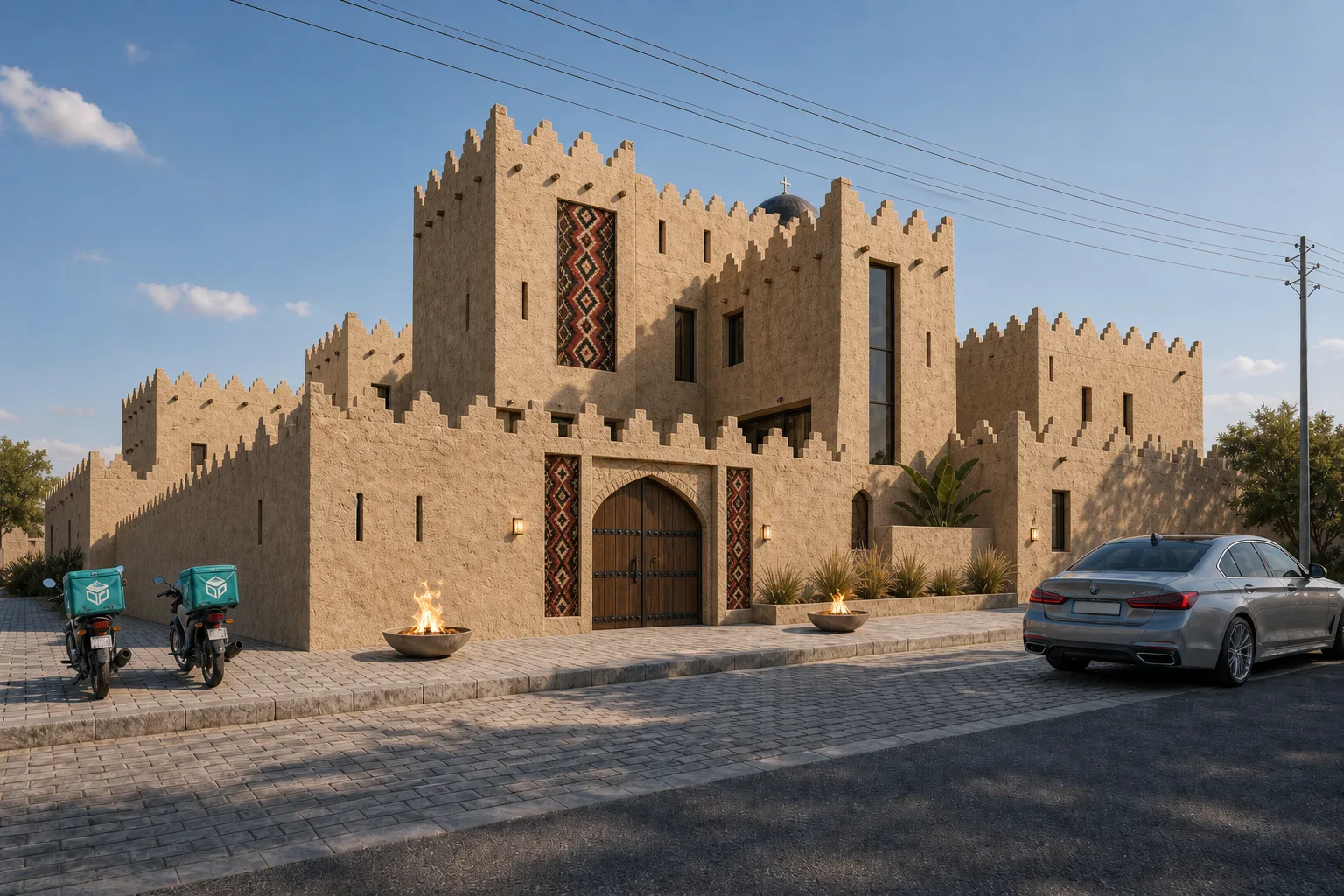
Contemporary Fortified Church Residence with Vernacular Desert Tectonics
Architectural Topic
Contemporary Fortified Church Residence with Vernacular Desert Tectonics is an architectural gallery study focused on exterior design, using nature-integrated contemporary, exterior, organic spatial flow to explain the image as a practical reference for facade, massing, material, and spatial decisions.
Formally, the massing works with a clear stereotomic logic: thick, sand-colored walls, tooth-like crenellations, and a largely planar envelope that evokes desert citadels rather than lightweight pavilions. A stepped hierarchy is set up between the outer enclosure, intermediate blocks, and the taller central tower volume, crowned in the distance by the dark dome. This vertical accent, pulled slightly off the main street datum, anchors the skyline while keeping the overall silhouette compact. The proportion system favors tall, slender wall segments punctuated by narrow slots, so the building reads first as continuous mass and only secondarily as a collection of rooms.
Surface articulation is almost entirely tectonic rather than ornamental, with the exception of the vertically stretched textile-like panels that flank the entry and reappear on the upper facade. These patterned insets behave as both visual datum and cultural signifier, breaking the monotony of the rough plaster texture and acting as a kind of woven screen frozen in the masonry field. Fenestration is sparingly deployed: deep-set vertical slits, a few larger glazed openings in the tower, and a corner window hovering above the entrance zone. This relative opacity, coupled with the crenellated skyline, prioritizes thermal and visual protection while allowing controlled frames of view, reinforcing a strong figure-ground legibility from the street.
The facade strategy balances defensive imagery with carefully edited permeability. Load paths are legible as continuous bearing walls running to the ground, with no obvious cantilevers or expressive structural gymnastics, which keeps the load-reading cues straightforward and archaic in spirit. Within that framework, the tall glazed slot in the main tower introduces a counterpoint of vertical light and reflection, suggesting a more open, contemplative interior volume behind the otherwise compact shell. Here the stereotomic mass gives way just enough to indicate a spatial climax at the heart of the plan, likely aligned with the vertical circulation core and possibly the chapel volume under the dome.
At ground level, the landscape interface is intentionally thin but choreographed: a raised plinth of pale stone pavers, linear planting beds of hardy grasses and a few tropical accents, and a pair of low fire bowls establish an axial approach to the timber gate. These elements help mediate between the heat-absorbing street and the cooler interior world implied behind the gate, while the long shadow cast by the parapets emphasizes the wall thickness and the diurnal performance of the envelope. The overall scene reads as contemporary because of the crisp rendering of edges, paired with the integration of cars, infrastructure, and modern door and window detailing, yet it stays contextually anchored through its fort-like massing hierarchy and reduced material palette. One can imagine this type of concept evolving through iterative facade studies, where tools such as https://www.toscape.ai/ would be used less for spectacle and more to test how subtle shifts in crenellation rhythm, window depth, or textile panel proportion recalibrate the building’s atmospheric modulation from austere bastion to quietly welcoming sanctuary.
Materials
The material reading is driven by mineral and stone-like tones, using surface depth, shadow, and warm neutral coloration to strengthen the facade's architectural identity.
Style
The style direction reads as nature-integrated contemporary, supported by exterior and organic spatial flow.
View the Sahara Desert Ksar / Kasbah style guideBuilding Type
Church
Facade Logic
The facade logic is organized around organic or parametric articulation, where repeated surface movement creates a unified envelope rather than a flat decorative skin.
Explore Related Keywords
1536 × 1024 px
Generation Receipt
Deterministic pipeline: the workflow, style direction and output size below are locked at generation time, so the same inputs reproduce the same visual language.
- Workflow
- Toscape workflow
- Style direction
- Sahara Desert Ksar / Kasbah
- Output
- 1536 x 1024 px
More from this category


Academy links
Material Swap for Facades and Interiors
Study how material changes alter facade and interior perception.
Re-Render for Concept and Client Review
Learn how to refine existing concepts while protecting studio imagery.
Integrating Toscape into Architectural Production
Connect AI image studies with professional studio workflows.