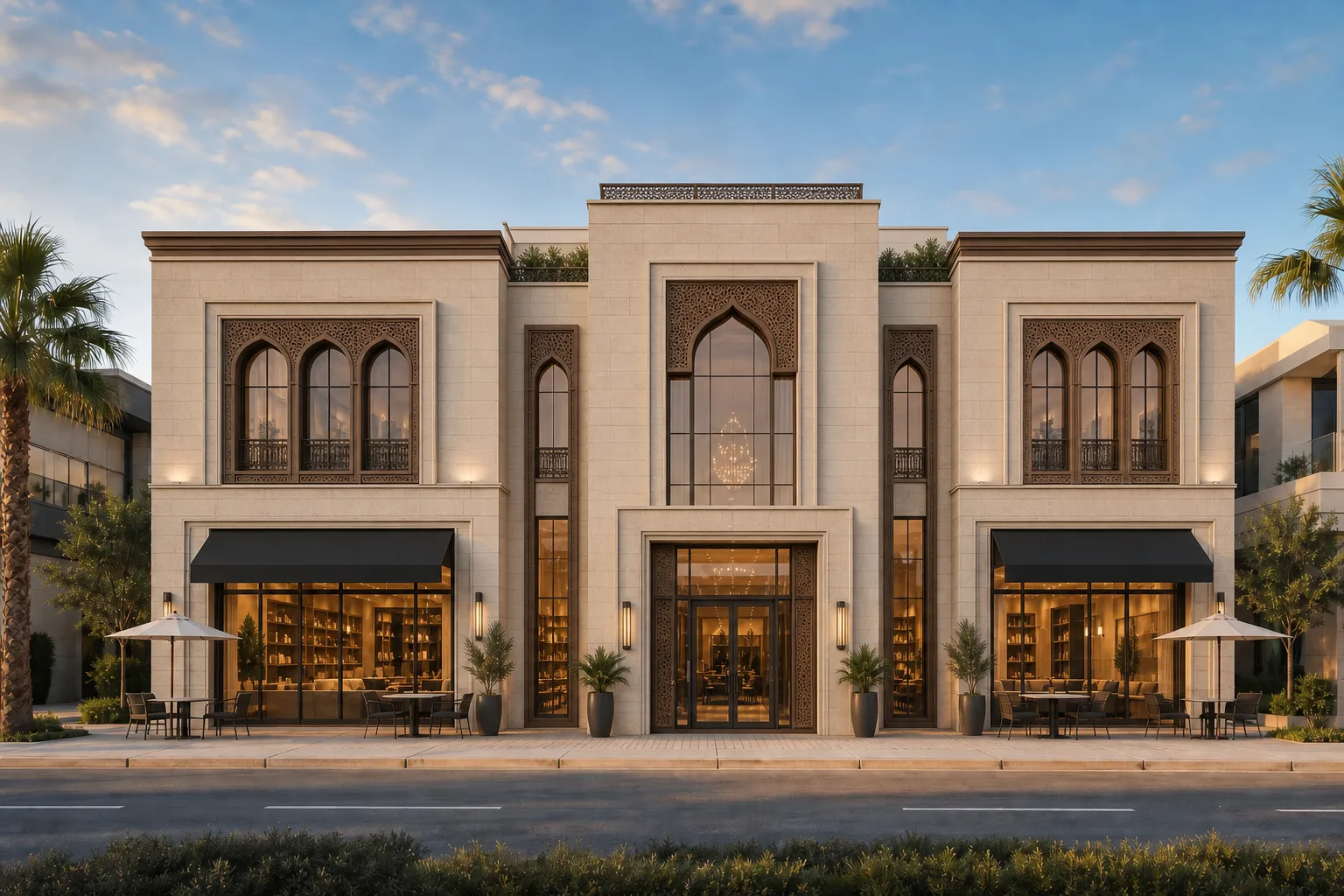
Contemporary Arcaded Façade with Reinterpreted Mashrabiya Motifs
Architectural Topic
Contemporary Arcaded Façade with Reinterpreted Mashrabiya Motifs is an architectural gallery study focused on exterior design, using contemporary neo-islamic, exterior, arched openings to explain the image as a practical reference for facade, massing, material, and spatial decisions.
Stylistically, the project works within a contemporary re-reading of Middle Eastern and North African architectural lineages, drawing especially on the pointed-arch window typology and perforated screen tradition without lapsing into pastiche. The façade deploys a restrained stereotomic logic: planar stone-like cladding constructs a calm primary mass, while the filigreed window surrounds and bronze-toned infill elements operate as tectonic appliqué. This contrast between heavy, continuous stone surfaces and delicate, shadow-producing tracery produces a legible hierarchy where structure reads as quiet background datum and ornament as thin, replaceable layer.
Massing is articulated as a tripartite composition: a dominant central volume pulled slightly forward, and two near-symmetrical side blocks. The central bay reinforces the main axis both in plan and elevation, its recessed entry frame generating a threshold depth absent from the more planar wings. Verticality is expressed not through sheer height but through the tall, slender window proportions and the repeated pointed arches that stretch across two levels. These arched apertures act as rhythmic uprights, while the continuous parapet line and cornice define a strong horizontal datum that visually ties the building back to the street. Load paths are implied rather than exposed, with the reading of stacked piers between window bays and a clear base–body–crown proportion system.
The façade logic is essentially a negotiation between transparency and environmental moderation. On the ground floor, large, nearly full-height glazing panels maximize visual permeability into warm, bookshelf-lined interiors, moderated by deep black awnings that serve as both shading devices and urban markers of commercial program. Upper-level apertures, by contrast, are more filtered: bronze-toned mullions and intricate screens set slightly in front of the glass suggest a secondary climatic skin that tempers light and glare while sustaining privacy. The narrow flanking windows around the central bay operate almost as light slits, reinforcing the vertical rhythm and subtly thickening the wall construction in those zones.
Materially, the envelope appears to rely on a high-uniformity, light-beige stone or stone-composite cladding, joined with tight, regular coursing that hints at a ventilated rainscreen or high-quality precast system rather than load-bearing masonry. Bronze or anodized aluminum frames and screens introduce a warmer metallic register, contrasting with the cooler stone and the dark, likely fabric awnings. The apparent precision of joints and the crispness of the chamfered reveals around the openings support a reading of industrialized components assembled into an apparently monolithic shell, rather than hand-carved construction. Under evening light, this palette yields a controlled gradient from sunlit stone to the amber interior glow, emphasizing depth at the reveals and carving the arches in shadow.
Materials
The material reading is driven by mineral and stone-like tones, using surface depth, shadow, and warm neutral coloration to strengthen the facade's architectural identity.
Style
The style direction reads as contemporary neo-islamic, supported by exterior and arched openings.
View the East Coast Contemporary style guideBuilding Type
Boutique Hotel
Facade Logic
The facade logic uses arches, screens, and layered openings to balance cultural reference, shading depth, and contemporary envelope rhythm.
Explore Related Keywords
1536 × 1024 px
Generation Receipt
Deterministic pipeline: the workflow, style direction and output size below are locked at generation time, so the same inputs reproduce the same visual language.
- Workflow
- Toscape workflow
- Style direction
- East Coast Contemporary
- Output
- 1536 x 1024 px
More from this category


Academy links
Material Swap for Facades and Interiors
Study how material changes alter facade and interior perception.
Re-Render for Concept and Client Review
Learn how to refine existing concepts while protecting studio imagery.
Integrating Toscape into Architectural Production
Connect AI image studies with professional studio workflows.