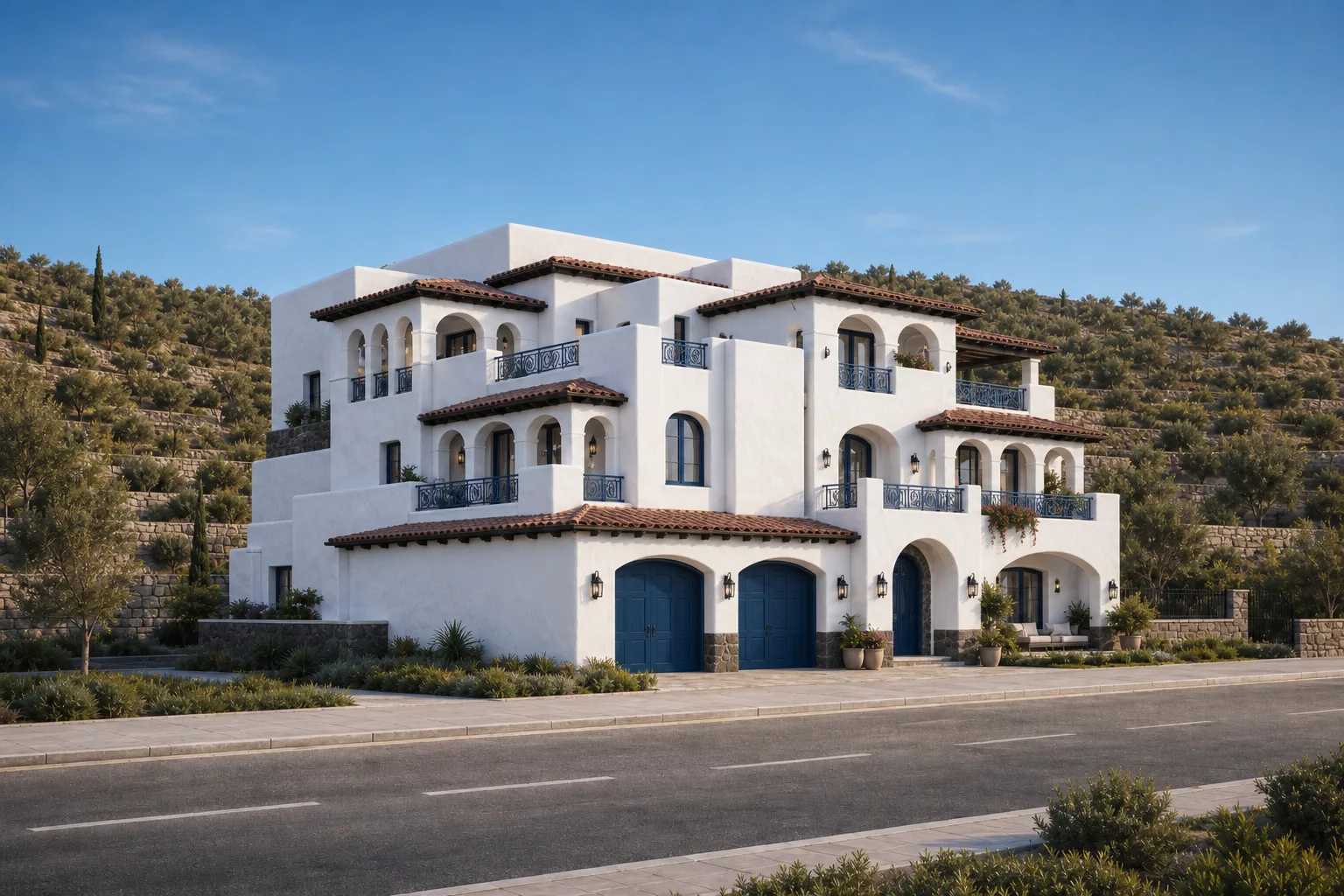
Stepped Mediterranean Villa with Layered Loggias and Hillside Context
Architectural Topic
Stepped Mediterranean Villa with Layered Loggias and Hillside Context is an architectural gallery study focused on exterior design, using contemporary neo-islamic, exterior, arched openings to explain the image as a practical reference for facade, massing, material, and spatial decisions.
Stylistically the project traces a Mediterranean and Spanish Colonial lineage, yet the composition is sharper and more edited than a literal revival. White, planar walls are allowed to read as primary masses, against which the repetitive arcades, slim iron balustrades, and clay-tile eaves act as a lighter tectonic layer. Proportionally, the scheme works with a clear base–middle–top hierarchy, the lower stereotomic zone anchored by stone plinths and the garage arches, the middle band articulated by continuous balconies, and the upper terraces trimmed back into simple, almost abstract boxes.
Massing strategy relies on a cascading arrangement of interlocking volumes stepping up and back with the slope behind, establishing a diagonal datum that visually binds the villa to the terraced hillside. Horizontal terra-cotta roof planes slice into this stepped figure, emphasizing the interleaving of covered and uncovered platforms. Verticality is read not through towers but through the stacking of voids: loggias aligned above one another create a soft, perforated edge, while solid corner piers maintain the perception of load-bearing thickness even if the actual structure may well be a conventional frame.
The facade logic is governed by a disciplined fenestration pattern that alternates arched openings in loggia zones with rectangular windows in more private interiors. Blue doors and window frames introduce a chromatic datum that aligns loosely across levels, while the blue wrought-iron balustrades act as a continuous, semi-porous screen mediating safety, views, and shadow. Shading is managed through generous eaves and recessed balconies, producing depth in the envelope and controlling solar gain; every major opening on sun-exposed faces is either under a tile roof or set back into a deep reveal, suggesting a climate-aware envelope performance.
Material stratigraphy is legible and deliberately restrained: smooth white stucco as the dominant skin, clay barrel tiles at all roof edges, darker stone at the base and around the garage thresholds, and fine metalwork at railings and lanterns. While the walls read as thick and monolithic, their crisp edges and uniform finish hint at contemporary construction methods rather than traditional masonry, a tension heightened by the almost rendered precision of light and shadow. It is easy to imagine this kind of facade and massing study evolving through iterative re-render workflows on platforms such as https://www.toscape.ai/, where subtle shifts in balcony depth or eave projection could be tested quickly against changing light conditions.
Materials
The material reading is driven by mineral and stone-like tones, using surface depth, shadow, and warm neutral coloration to strengthen the facade's architectural identity.
Style
The style direction reads as contemporary neo-islamic, supported by exterior and arched openings.
View the Mediterranean Revival style guideBuilding Type
Luxury Villa
Facade Logic
The facade logic uses arches, screens, and layered openings to balance cultural reference, shading depth, and contemporary envelope rhythm.
Explore Related Keywords
1536 × 1024 px
Generation Receipt
Deterministic pipeline: the workflow, style direction and output size below are locked at generation time, so the same inputs reproduce the same visual language.
- Workflow
- Toscape workflow
- Style direction
- Mediterranean Revival
- Output
- 1536 x 1024 px
More from this category


Academy links
Material Swap for Facades and Interiors
Study how material changes alter facade and interior perception.
Re-Render for Concept and Client Review
Learn how to refine existing concepts while protecting studio imagery.
Integrating Toscape into Architectural Production
Connect AI image studies with professional studio workflows.