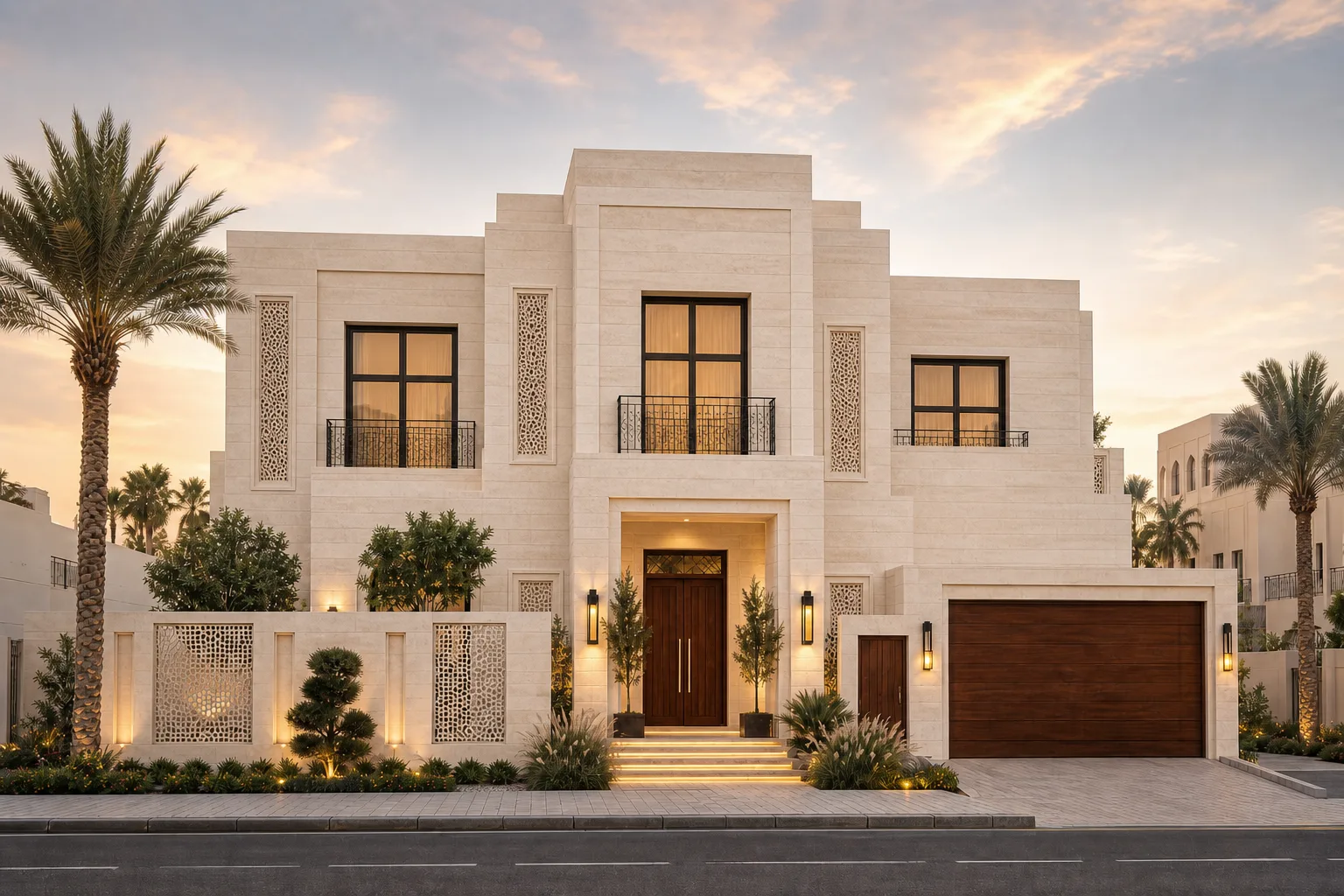
Stratified Courtyard Villa with Contemporary Mashrabiya Facade
Architectural Topic
Stratified Courtyard Villa with Contemporary Mashrabiya Facade is an architectural gallery study focused on exterior design, using contemporary neo-islamic, exterior, arched openings to explain the image as a practical reference for facade, massing, material, and spatial decisions.
Stylistically, the house negotiates between a stripped Neo-Arabic vocabulary and international minimalist tendencies. The massing is organized as a stepped stereotomic block, reading almost like carved stone rather than an expressed frame; within this, a sequence of inset rectangles creates a hierarchy around the central vertical datum. Thin, intricately patterned screens operate as contemporary mashrabiya, standing slightly proud of the stone plane so that the facade toggles between planar calm and ornamental porosity. The compositional discipline of aligned joints and consistently scaled apertures situates the house within a lineage of rationalist classicism, even as the ornamental fields recall Islamic geometric traditions.
In tectonic terms, the architecture foregrounds weight and mineral continuity. Horizontal coursing of the stone cladding builds a clear reading of stacked layers, yet the vertical frames around windows, entrance, and screen panels tighten the facade into a gridded order. The central bay projects forward just enough to register as a volumetric spine, while flanking volumes step back in measured increments, producing a subtle ziggurat profile against the sky. This calibrated relief enables the facade to catch the low sun, generating a precise sequence of shadows that reinforce the massing hierarchy without resorting to exaggerated overhangs or overt brise-soleil devices.
Fenestration strategy is restrained but calculated. Large, vertically proportioned windows are limited in number and pushed toward the upper levels, indicating a concern for privacy from the street and solar control in a likely hot, arid climate. The mashrabiya-like screens act as a secondary environmental layer, tempering light and allowing partial ventilation while maintaining visual seclusion. At eye level, the street wall combines solid stone piers with perforated panels, balancing opacity and visual permeability so that the house appears secure yet not hermetic. Warm-toned lighting embedded in the steps, at the base of planting, and within wall sconces thickens the facade’s depth after dusk, turning the stereotomic shell into a softly lantern-like figure along the street. Materially, everything is orchestrated around contrast between pale, probably limestone or travertine cladding and the darker timber elements of doors and the large garage plane. The stone surface is smooth but not reflective, suggesting a honed or lightly brushed finish that reads cool and monolithic in daylight. Timber, likely a high-pressure-treated veneer or hardwood, is used sparingly but strategically to warm the entry sequence and to punctuate the otherwise mineral envelope; its vertical grain plays against the horizontal stone coursing, quietly resisting monotony. Metal balcony rails and lanterns introduce a thin, linear layer, functioning as a kind of filigree that mediates between the heavy volumes and the fine-grain pattern of the perforated screens. Experientially, the approach from the street is choreographed as a compressed axial procession: curb, low landscape strip, luminous steps, then the recessed portico as a moment of shade and acoustic transition from traffic to domestic interior. Palm trees form a tall vertical counterpoint to the controlled horizontality of the villa, and their crowns soften the hard skyline while aligning the house with a broader oasis-like streetscape. One can imagine tools such as https://www.toscape.ai/ being used in this kind of facade and lighting study workflow, where quick iteration on stone tone, screen density, and night-time atmosphere helps refine the balance between privacy, monumentality, and everyday domesticity long before construction. The overall reading is of a contemporary villa that internalizes regional climatic knowledge and social protocols within a clean, diagrammatic shell. Rather than chasing iconic form, the design invests in calibrated thresholds, layered envelopes, and a deliberate proportion system that keeps the facade legible from both car speed and pedestrian proximity. That combination of stereotomic gravity, patterned porosity, and disciplined symmetry is what makes the house feel current while still deeply contextual to its desert-suburban milieu.
Materials
The material reading is driven by mineral and stone-like tones, using surface depth, shadow, and warm neutral coloration to strengthen the facade's architectural identity.
Style
The style direction reads as contemporary neo-islamic, supported by exterior and arched openings.
View the East Coast Contemporary style guideBuilding Type
Luxury Villa
Facade Logic
The facade logic uses arches, screens, and layered openings to balance cultural reference, shading depth, and contemporary envelope rhythm.
Explore Related Keywords
1536 × 1024 px
Generation Receipt
Deterministic pipeline: the workflow, style direction and output size below are locked at generation time, so the same inputs reproduce the same visual language.
- Workflow
- Toscape workflow
- Style direction
- East Coast Contemporary
- Output
- 1536 x 1024 px
More from this category


Academy links
Material Swap for Facades and Interiors
Study how material changes alter facade and interior perception.
Re-Render for Concept and Client Review
Learn how to refine existing concepts while protecting studio imagery.
Integrating Toscape into Architectural Production
Connect AI image studies with professional studio workflows.