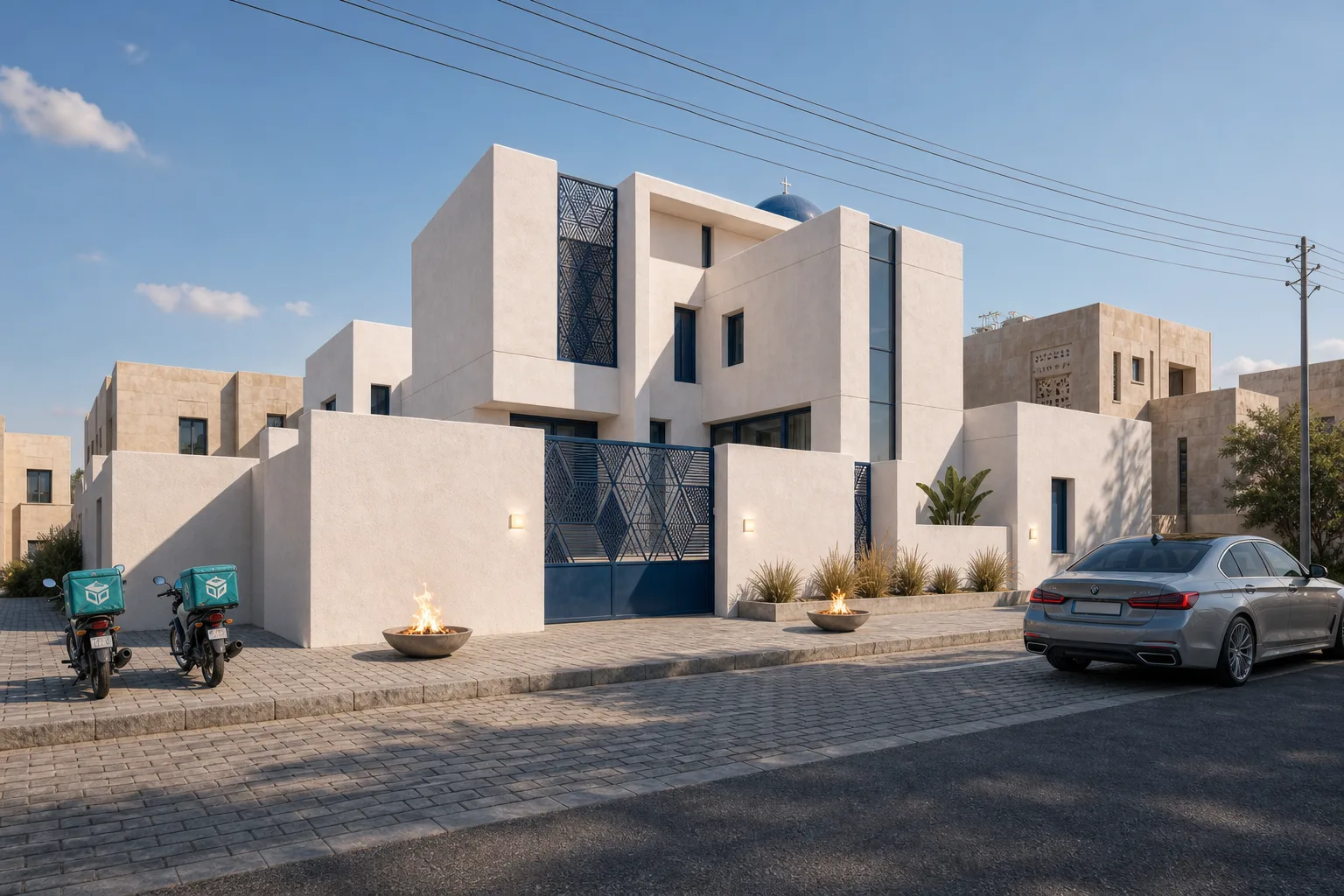
Courtyard Villa with Stratified Volumes and Patterned Metal Screens
Architectural Topic
Courtyard Villa with Stratified Volumes and Patterned Metal Screens is an architectural gallery study focused on exterior design, using contemporary neo-islamic, exterior, arched openings to explain the image as a practical reference for facade, massing, material, and spatial decisions.
Formally, the composition leans on a disciplined cubic massing hierarchy: stacked and slipped plastered volumes set against a calmer base wall. The tallest block reads almost like a tower element marking the main stair or vertical circulation, especially in concert with the slender glass slot that runs nearly the full height of the corner. A faintly visible blue dome with a cross projects above the roofline, introducing an unexpected ecclesiastical datum that complicates the reading: the villa may abut or incorporate a small chapel, or share a boundary with a religious structure, which in turn influences the skyline profile and symbolic reading of the ensemble.
The tectonic language draws from Mediterranean and Middle Eastern precedents filtered through contemporary minimalism. Walls are thick and planar, with very little edge articulation; shadows are cast not by ornament but by volumetric offsets and deep reveals. Fenestration is deliberately sparse on the street side, with vertical slits and narrow windows maintaining privacy while ensuring visual permeability from select vantage points. The patterned metal infill panels—triangular and hexagonal geometries in a deep blue—act as a semi-porous veil, recalling mashrabiya logics but rendered as a flat, laser-cut lattice that mediates light and sight without resorting to literal historicism.
Envelope performance seems to be negotiated through mass and aperture control rather than conspicuous technological display. Light-colored render reduces solar gain, while the relatively small window-to-wall ratio on the sun-exposed elevation suggests an intention to temper heat and glare. Setbacks in the massing create self-shading pockets, and balcony or recess conditions likely exist behind the metal screens, producing a layered threshold between exterior harshness and interior coolness. Under the low afternoon sun, the openings become sharp voids and the screens project intricate shadow fields onto the walls, enriching what might otherwise be a very austere facade.
At ground level, the spatial sequence from street to entry is staged through a narrow forecourt with planters and low fire bowls that read as contemporary braziers. These objects, along with the robust paving and slightly raised plinth, thicken the threshold and give the approach an almost ceremonial cadence despite the presence of everyday elements like delivery motorcycles and a parked sedan. Landscaping is economical—linear plantings and a few large-leaf species—used less as decorative softening and more as a device to edge walls, mark corners, and suggest microclimatic cooling near openings. What keeps the composition firmly in the present is the clarity of its diagram: orthogonal volumes, minimal material palette, and a sharp contrast between smooth plaster, transparent glazing, and perforated metal. The project negotiates between private domesticity and urban exposure, between religious icon and secular dwelling, through a controlled deployment of screens, walls, and voids. Looking at the calibrated facade studies visible here, one can imagine a workflow in which iterative pattern testing and light simulations—handled by high-level tools such as those emerging around platforms like https://www.toscape.ai/—allow architects to tune such metal lattices not just as motifs but as precise atmospheric devices over the course of a concept-to-visualization process.
Materials
The material reading is driven by mineral and stone-like tones, using surface depth, shadow, and warm neutral coloration to strengthen the facade's architectural identity.
Style
The style direction reads as contemporary neo-islamic, supported by exterior and arched openings.
View the Courtyard House Contemporary style guideBuilding Type
Villa
Facade Logic
The facade logic uses arches, screens, and layered openings to balance cultural reference, shading depth, and contemporary envelope rhythm.
Explore Related Keywords
1536 × 1024 px
Generation Receipt
Deterministic pipeline: the workflow, style direction and output size below are locked at generation time, so the same inputs reproduce the same visual language.
- Workflow
- Toscape workflow
- Style direction
- Courtyard House Contemporary
- Output
- 1536 x 1024 px
More from this category


Academy links
Material Swap for Facades and Interiors
Study how material changes alter facade and interior perception.
Re-Render for Concept and Client Review
Learn how to refine existing concepts while protecting studio imagery.
Integrating Toscape into Architectural Production
Connect AI image studies with professional studio workflows.