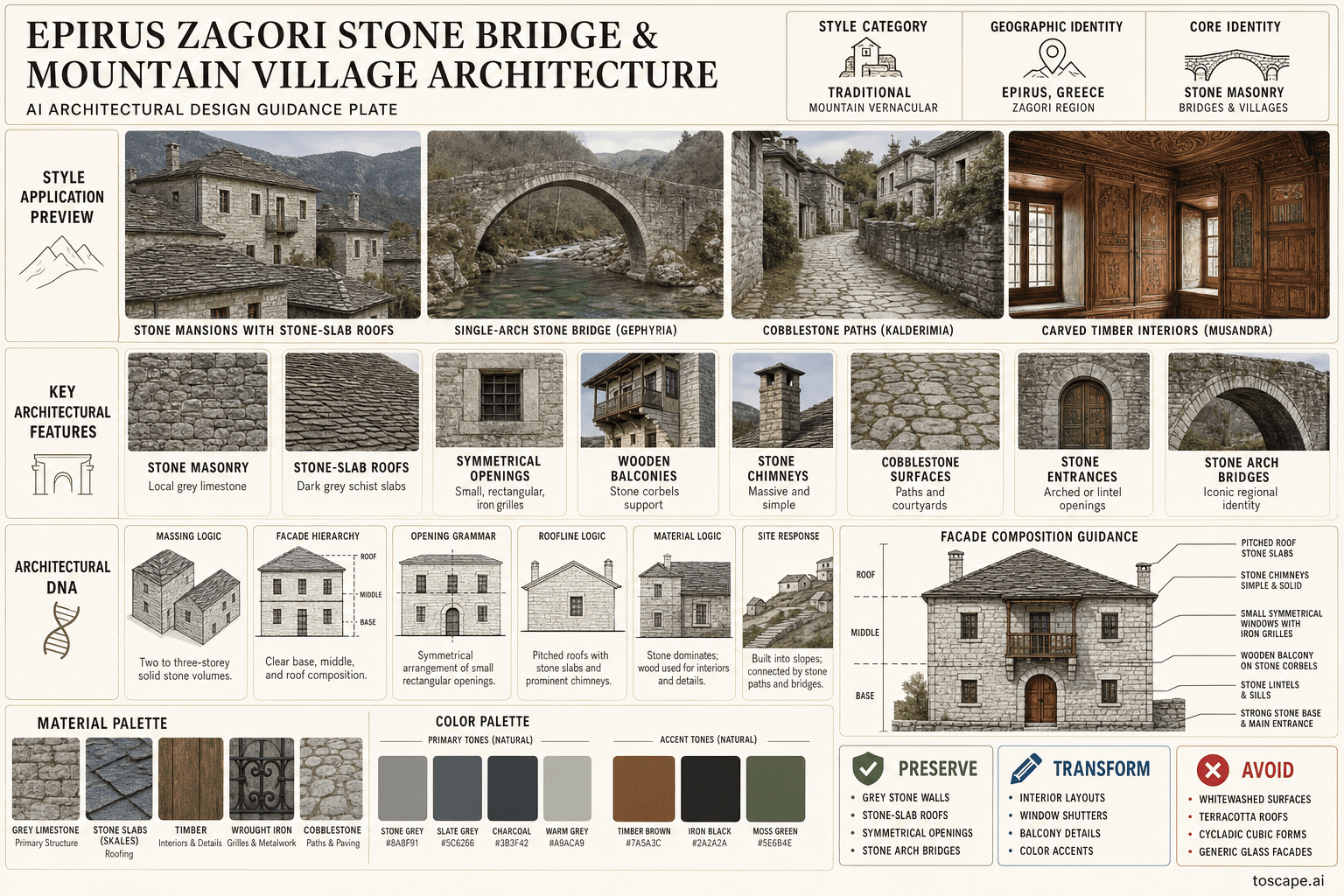
Epirus Zagori Stone Bridge & Mountain Village
Greece · Zagorochoria (Zagori villages) of Epirus, northwestern Greece
The Ottoman-influenced stone mansions of northwestern Greece — arched bridges, stone-slab roofs, and the Zagorochoria villages
Definition
Epirus Zagori Stone Bridge & Mountain Village is a regional architectural identity from Greece. The Ottoman-influenced stone mansions of northwestern Greece — arched bridges, stone-slab roofs, and the Zagorochoria villages.
- Country
- Greece
- Region
- Zagorochoria (Zagori villages) of Epirus, northwestern Greece.
- Massing
- Grey limestone mansions (archontika) — two-to-three storey stone houses with distinctive stone-slab roofs (schist plates.
- Palette
- Warm earth, sandy beige, ochre, clay brown, and sun-softened mineral tones should dominate, with palm green or weathered timber as secondary accents.
- Climate response
- The Zagorochoria (Zagori villages) of Epirus, northwestern Greece — a UNESCO World Heritage cultural landscape (inscribed 2023) representing the apogee of Epirote stone masonry.
Try it free
Render your own project in this style
Upload one photo of your own project and Re-Render keeps the geometry and camera while carrying the Epirus Zagori Stone Bridge & Mountain Village language into materials, proportion, and detail. Three free renders, no account needed.
Open Re-Render - freeOverview
Epirus Zagori Stone Bridge & Mountain Village is a regional architectural identity in Greece. The Zagorochoria (Zagori villages) of Epirus, northwestern Greece — a UNESCO World Heritage cultural landscape (inscribed 2023) representing the apogee of Epirote stone masonry. Grey limestone mansions (archontika) — two-to-three storey stone houses with distinctive stone-slab roofs (schist plates, not ceramic tiles) — the "skales" (slate roofs) of Zagori — massive stone walls (600–800 mm) — small, symmetrically arra...
Visual DNA
Massing & Form
Grey limestone mansions (archontika) — two-to-three storey stone houses with distinctive stone-slab roofs (schist plates, not ceramic tiles) — the "skales" (slate roofs) of Zagori — massive stone walls (600–800 mm) — small, symmetrically arranged windows with iron grilles — the iconic single-arch stone bridges (gephyri...
Facade Language
Grey limestone mansions (archontika) — two-to-three storey stone houses with distinctive stone-slab roofs (schist plates, not ceramic tiles) — the "skales" (slate roofs) of Zagori — massive stone walls (600–800 mm) — small, symmetrically arranged windows with iron grilles — the iconic single-arch stone bridges (gephyri...
Materials & Texture
Grey limestone mansions (archontika) — two-to-three storey stone houses with distinctive stone-slab roofs (schist plates, not ceramic tiles) — the "skales" (slate roofs) of Zagori — massive stone walls (600–800 mm) — small, symmetrically arranged windows with iron grilles — the iconic single-arch stone bridges (gephyri...
Color Palette
Warm earth, sandy beige, ochre, clay brown, and sun-softened mineral tones should dominate, with palm green or weathered timber as secondary accents. The palette should read as land-derived rather than polished or urban-generic.
Ornament & Detail
Grey limestone mansions (archontika) — two-to-three storey stone houses with distinctive stone-slab roofs (schist plates, not ceramic tiles) — the "skales" (slate roofs) of Zagori — massive stone walls (600–800 mm) — small, symmetrically arranged windows with iron grilles — the iconic single-arch stone bridges (gephyri...
Climate Response
The Zagorochoria (Zagori villages) of Epirus, northwestern Greece — a UNESCO World Heritage cultural landscape (inscribed 2023) representing the apogee of Epirote stone masonry
Landscape & Ground
The Zagorochoria (Zagori villages) of Epirus, northwestern Greece — a UNESCO World Heritage cultural landscape (inscribed 2023) representing the apogee of Epirote stone masonry
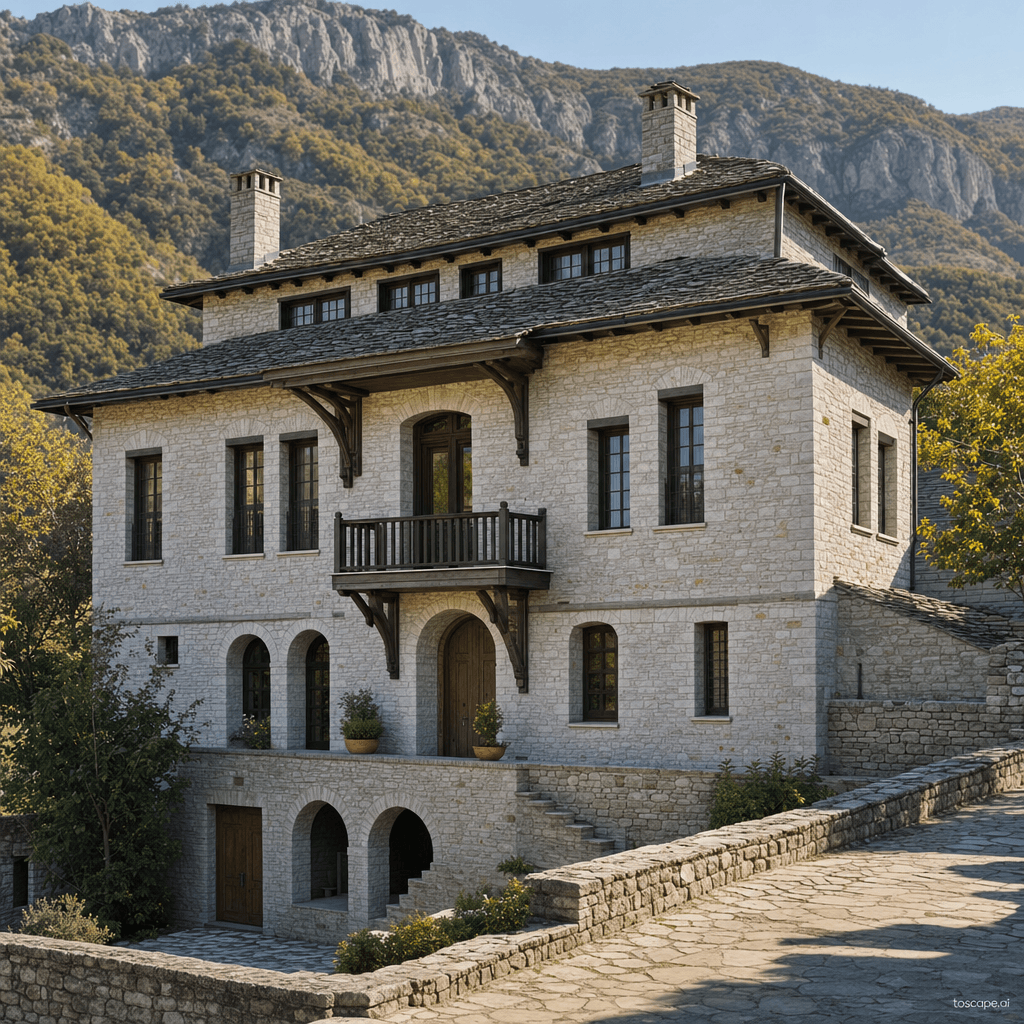
Reference elevation
Epirus Zagori Stone Bridge & Mountain Village — characteristic facade composition, Zagorochoria (Zagori villages) of Epirus, northwestern Greece.
Context Snapshot
The Zagorochoria (Zagori villages) of Epirus, northwestern Greece — a UNESCO World Heritage cultural landscape (inscribed 2023) representing the apogee of Epirote stone masonry
Contemporary Relevance
Epirus Zagori Stone Bridge & Mountain Village is useful today for residential, hospitality, civic, and place-branding work that needs Greece-specific character grounded in local massing, material tone, climate response, and settlement logic rather than generic international styling.
Use this style in Toscape
Explore Epirus Zagori Stone Bridge & Mountain Village directly inside Toscape using the Facade Re-Style and Design Options workflows.
Open Epirus Zagori Stone Bridge & Mountain Village in the galleryFrequently asked questions
What is Epirus Zagori Stone Bridge & Mountain Village?
Epirus Zagori Stone Bridge & Mountain Village is a regional architectural identity from Greece. The Ottoman-influenced stone mansions of northwestern Greece — arched bridges, stone-slab roofs, and the Zagorochoria villages.
What materials define Epirus Zagori Stone Bridge & Mountain Village?
Grey limestone mansions (archontika) — two-to-three storey stone houses with distinctive stone-slab roofs (schist plates, not ceramic tiles) — the "skales" (slate roofs) of Zagori — massive stone walls (600–800 mm) — small, symmetrically arranged windows with iron grilles — the iconic single-arch stone bridges (gephyri.
What is the Epirus Zagori Stone Bridge & Mountain Village color palette?
Warm earth, sandy beige, ochre, clay brown, and sun-softened mineral tones should dominate, with palm green or weathered timber as secondary accents. The palette should read as land-derived rather than polished or urban-generic.
Where does Epirus Zagori Stone Bridge & Mountain Village come from?
The Zagorochoria (Zagori villages) of Epirus, northwestern Greece — a UNESCO World Heritage cultural landscape (inscribed 2023) representing the apogee of Epirote stone masonry.
When should architects use Epirus Zagori Stone Bridge & Mountain Village?
Epirus Zagori Stone Bridge & Mountain Village is useful today for residential, hospitality, civic, and place-branding work that needs Greece-specific character grounded in local massing, material tone, climate response, and settlement logic rather than generic international styling.
How do you render Epirus Zagori Stone Bridge & Mountain Village in Toscape?
Load your project image in Toscape, select the Epirus Zagori Stone Bridge & Mountain Village reference, and process the run. The Facade Re-Style and Design Options workflows preserve the existing geometry and viewpoint while redirecting materials, proportion, and detail toward Epirus Zagori Stone Bridge & Mountain Village.
Other regional identities from Greece
- Peloponnese Stone Tower & VillageThe Mani tower-houses and Arcadian stone villages — fortified clan architecture of southern Greece.
- Santorini Volcanic CalderaThe earth-sheltered cave architecture of the Santorini caldera.
- Corfu Ionian Island VenetianThe Venetian-influenced urban architecture of the Ionian Islands — Italian Renaissance meets Greek island vernacular.
- Crete Venetian-Ottoman HybridThe layered island architecture of Crete — Minoan memory, Venetian fortification, Ottoman adaptation, and Aegean vernacular.
- Cyclades IslandsThe iconic whitewashed cubic architecture of the Aegean islands — Santorini, Mykonos, and the Cycladic archipelago.
- Macedonian Urban BalkanThe Ottoman-influenced urban houses of Thessaloniki and northern Greece — Balkan timber-framed mansions and the "Ano.